NCF-SE in Mathematics: Complete Guide to National Curriculum Framework 2023

NCF-SE in Mathematics: Complete Guide to National Curriculum Framework 2023
Understanding the Five-Fold Development Approach in Mathematics Education for Classes 6-8
NCF-SE in Mathematics represents a revolutionary transformation in India’s National Curriculum Framework for School Education 2023. This framework goes beyond teaching just numbers and formulas, focusing instead on the overall development of students. Whether you are a student, parent, or teacher, this guide is essential as it explains how mathematics education has evolved into a Five-Fold Development approach that creates a holistic learning experience.
Table of Contents
- What is NCF-SE and Why is it Important?
- Five-Fold Development: Understanding the Five Dimensions
- 1. Sharirik Vikas (Physical Development)
- 2. Manasik Vikas (Emotional/Mental Development)
- 3. Pranik Vikas (Development of Life Energy)
- 4. Bauddhik Vikas (Intellectual Development)
- 5. Chaitisik Vikas (Spiritual Development)
- Key Features of NCF-SE
- Benefits for Students
- How is it Being Implemented in Classrooms
- Frequently Asked Questions
What is NCF-SE and Why is it Important?
NCF-SE (National Curriculum Framework for School Education) 2023 is a comprehensive educational framework launched by the Government of India, designed to revolutionize mathematics education for classes 6 to 8. Instead of merely providing theoretical knowledge, it develops students through practical, activity-based learning.
What Makes This Framework Special?
In the traditional education system, mathematics was limited to just numbers and calculations. However, NCF-SE 2023 develops students as complete individuals – physically, mentally, intellectually, spiritually, and emotionally. This approach helps in solving real-life problems effectively.
This framework follows the vision of NEP 2020 (National Education Policy 2020) and emphasizes holistic development. Its main objective is to develop critical thinking, creativity, problem-solving skills, and life skills in students.
Five-Fold Development: Understanding the Five Dimensions
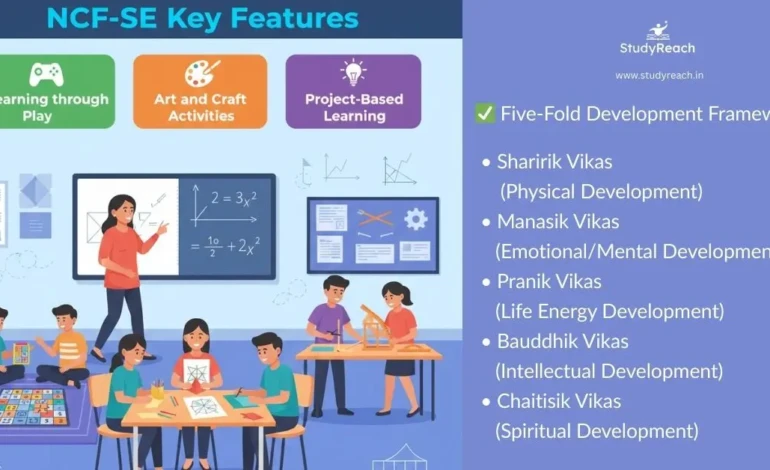
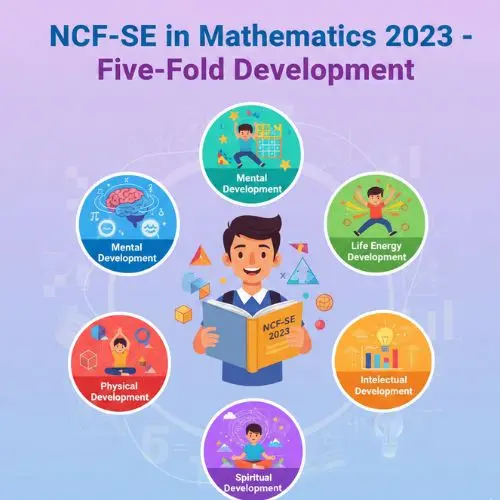
The core concept of NCF-SE in Mathematics is Five-Fold Development or Panchakosha Vikas. This is based on ancient Indian philosophy that believes human development occurs in five dimensions. Let’s understand in detail:
Sharirik Vikas
(Physical Development)
This development focuses on physical fitness, nutrition, hygiene, and body building. Mathematics includes activities that keep students physically active.
Example: Outdoor activities for creating shapes in Geometry, physical games for measurements, or yoga exercises through mathematical patterns.
Benefits: Better concentration, improved stamina, healthy lifestyle habits, and physical coordination development.
Manasik Vikas
(Emotional/Mental Development)
Focus on students’ emotional intelligence and mental health. While solving math problems, frustration management, patience, and emotional balance are taught.
Example: Collaboration in group activities, learning from mistakes, and building resilience through challenging problems.
Benefits: Stress management, emotional regulation, positive mindset, and mental wellbeing.
Pranik Vikas
(Development of Life Energy)
Activities that develop positive energy and enthusiasm. Making mathematics interesting and engaging so that natural curiosity awakens in students.
Example: Math games, puzzles, competitive activities, and real-world applications that generate excitement.
Benefits: Increased motivation, positive attitude towards learning, energy boost, and active participation.
Bauddhik Vikas
(Intellectual Development)
Emphasis on observation skills, analytical thinking, and logical reasoning. Students are taught to look at problems from different angles.
Example: Pattern recognition, data analysis, mathematical proofs, and logical problem-solving activities.
Benefits: Enhanced critical thinking, better decision-making, improved analytical skills, and academic excellence.
Chaitisik Vikas
(Spiritual Development)
Focus on values, ethics, and inner peace. Understanding universal truths, patterns in nature, and interconnectedness through mathematics.
Example: Exploring mathematical patterns in nature, ethical problem-solving, and collaborative learning.
Benefits: Value-based education, ethical awareness, inner peace, and holistic perspective.
Key Features of NCF-SE
NCF-SE in Mathematics is based on three major teaching-learning approaches that are completely different from traditional rote learning:
Learning through Play
Students easily understand concepts through play. Textbooks include free play, guided play, and structured play activities that make learning fun and effective.
Example: Number games, mathematical puzzles, board games with math concepts, outdoor measurement activities.
Learning through Art and Craft
Through art and craft, students can express their ideas, emotions, and feelings. Drawing, painting, and pasting activities make mathematical concepts creative.
Example: Creating art with geometric shapes, designing symmetry patterns, understanding fractions through origami.
Project-based Approach
Learning by doing – students explore on their own through practical activities, share ideas, and collaborate with peers. This develops creativity, critical thinking, and problem-solving skills.
Example: Community surveys for data collection, budget planning projects, creating mathematical models.
Benefits for Students
- Conceptual Understanding: Deep understanding of concepts instead of rote learning, which helps in long-term retention.
- Practical Skills: The ability to apply mathematics in real-life situations develops, which remains useful even after exams.
- Reduced Math Anxiety: Activity-based learning reduces the fear of mathematics and makes the subject enjoyable.
- Holistic Development: Not just academic excellence but overall personality development occurs – physical, mental, emotional, intellectual, and spiritual.
- 21st Century Skills: Critical thinking, creativity, collaboration, and communication skills develop naturally.
- Self-paced Learning: Every student can learn at their own speed, without any pressure or comparison.
- Exam Preparedness: With clear concepts, there is an advantage in preparing for competitive exams (JEE, NEET, Olympiads).
- Life Skills: Skills like problem-solving, decision-making, and analytical thinking that are always useful in your career.
How is it Being Implemented in Classrooms
NCF-SE in Mathematics: Specific strategies are being followed to successfully implement NCF-SE 2023 in schools:
Role of Teachers
Teachers are now working as facilitators. They give students the freedom to explore, encourage them to ask questions, and address each student’s individual learning needs. The focus is on interactive sessions, discussions, and hands-on activities instead of the traditional lecture method.
Textbooks and Learning Material
NCERT’s new textbooks follow NCF-SE guidelines. They include colorful illustrations, real-life examples, activity boxes, and practice exercises that cater to different learning styles. A bilingual approach (Hindi-English mix) is also being used so that students can understand easily.
Assessment Methods
Along with traditional exams, continuous assessment, project work, practical activities, and peer assessment are also included. This approach provides students with comprehensive evaluation and does not focus only on marks.
Suggestions for Parents
Parents should also actively participate in this new approach. Play mathematical games at home, discuss math concepts in daily life (calculations while shopping, measurements in cooking), and encourage children to learn from mistakes. Let them enjoy the learning process instead of putting pressure on them.
📌 Related Resources and Links
Internal Links (Read More on StudyReach.in):
External Links (Official Resources):
Frequently Asked Questions (FAQs)
NCF-SE 2023 is primarily implemented for classes 6 to 8, but its principles are gradually being applied in all classes. In mathematics textbooks, this approach is fully visible in classes 6, 7, and 8 where Five-Fold Development and activity-based learning have been integrated.
Absolutely! NCF-SE focuses on conceptual understanding which is essential for excellent performance in board exams. Students who understand concepts deeply can solve any type of questions. Additionally, practical applications and problem-solving skills are very helpful in competitive exams (JEE, NEET, Olympiads) as well.
NCF-SE in Mathematics : Parents can support in many ways at home: (1) For Physical Development, encourage outdoor mathematical activities, (2) For Mental Development, play puzzles and brain games, (3) For Pranik Vikas, let children explore hobbies, (4) For Intellectual Development, promote asking “why” questions, (5) For Spiritual Development, take them to observe patterns in nature. The main point is to make learning pressure-free and enjoyable.
Traditional methods focused on rote learning, formula memorization, and repetitive practice. The NCF-SE approach emphasizes understanding concepts, practical applications, activity-based learning, and holistic development. Instead of lecturing, teachers become facilitators, students become active learners instead of passive listeners, and assessment measures overall growth instead of just marks.
Yes, absolutely! The biggest strength of NCF-SE is that it promotes inclusive education. Activity-based learning and play-way methods give slow learners the opportunity to understand at their own pace. The multi-sensory approach (visual, auditory, kinesthetic) accommodates different learning styles. Additionally, peer learning occurs in collaborative activities which is beneficial for all students. No competition or comparison – every student’s individual growth is celebrated.
NCF-SE aligned textbooks are published by NCERT and can be downloaded for free from the NCERT official website (ncert.nic.in). Physical copies can also be purchased through schools or online platforms (Amazon, Flipkart). E-books are also available which can be read on tablets or smartphones, making them accessible to all students.
Shailendra Porwal is an experienced education professional and content strategist. Founder of StudyReach.in. With years of work in school leadership and student guidance, he writes to simplify educational updates for students, parents, and teachers. Studyreach.in brings you timely information about CBSE circulars, scholarship programs, and career guidance to help students excel academically. Stay updated.
Share this opportunity with fellow students. Friends know about the UPSC 2026 Letter Writing Competition.
Click for More updates on CBSE News and Circulars