The AI Cheating in Schools

AI Cheating in Schools: Are Students Still Learning, or Just Submitting AI-Generated Work?
By Shailendra Porwal | StudyReach
From India to the United States and beyond, classrooms face the same question: is AI helping students learn, or learning on their behalf?
If a student submits a perfect essay but cannot explain what it means, has that student really learned anything?
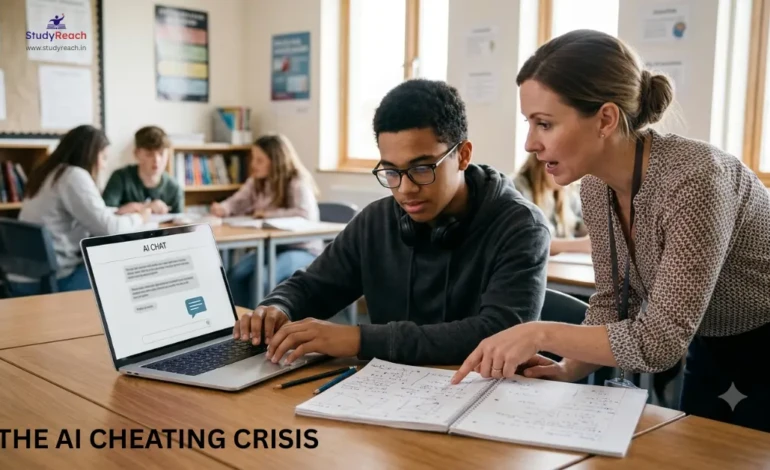
AI cheating in schools is no longer a problem of one country or one type of school. Picture a student with a laptop and an assignment due tomorrow. Instead of reading the chapter or writing a rough draft, the student types a prompt into an AI chatbot and gets a polished answer in seconds. A few edits later, it is submitted.
The grammar is perfect. The structure is clear. But the student may not understand a single idea in it.
Is that smart use of technology, academic dishonesty, or a sign that schools must rethink how they teach and assess? As an education leader, I believe the answer is: all three, depending on how AI is used.
- What research from different parts of the world says
- When AI help becomes AI cheating
- Why AI detectors cannot be the final judge
- What teachers, parents, students and schools can do
1. AI Has Changed Homework. Has Learning Changed Too?
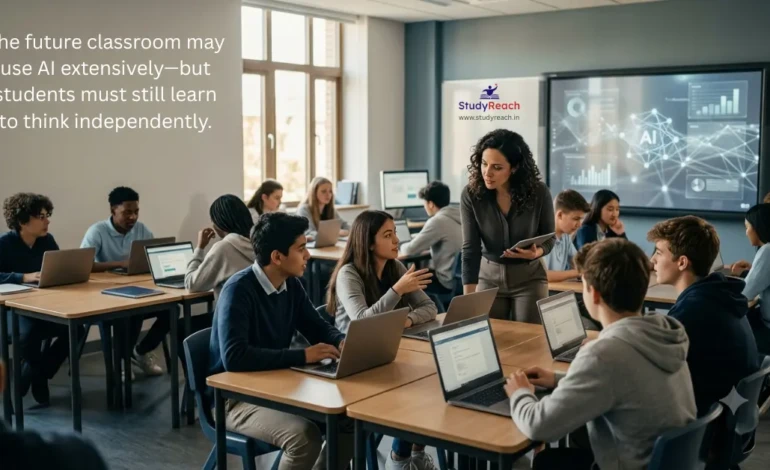
AI tools can now explain difficult topics, summarise chapters, write essays, solve maths problems and build presentations. Used well, this is powerful. A student can ask for a simpler explanation, get feedback on a draft or practise exam questions.
But when AI completes the whole assignment and the student submits it as their own, the purpose of the assignment is lost. If an essay exists to build research, reasoning and writing skills, what happens when a machine does all three? The grade may look good. The learning may never have happened.
2. What Does the Research Say?
This is not just a theoretical worry. Two sources show how widely schools are struggling.
Harvard Center for Digital Thriving (USA, October 2026)
A national survey of more than 1,000 U.S. public-school teachers and principals, plus interviews with educators and students, found:
- 25% of teachers and 29% of principals said AI had created difficult dilemmas in their schools or classrooms.
- Among those reporting a dilemma, 74% of teachers and 69% of principals described suspected student misuse.
- Only 18% of teachers and 24% of principals said their school had a specific generative AI policy.
Source: Harvard Graduate School of Education, 6 October 2026
UNESCO (global, 2023)
A UNESCO survey of more than 450 schools and universities found that fewer than 10% had institutional policies or formal guidance on generative AI. UNESCO urged governments to regulate its use in education, train teachers and protect student data.
The Harvard researchers also describe a “two-way suspicion” problem: teachers worry students are using AI to cheat, while students fear being accused even when they are not. When that happens, trust, the foundation of learning, suffers.
These findings do not mean every student is cheating. They show that unclear rules create confusion for everyone. So the better question is not “Are students using AI?” but “How are they using it, and what are they learning?”
3. When Does AI Help Become AI Cheating?
It depends on the assignment, the teacher’s instructions and the student’s honesty about the help received.
| Use of AI | What it means |
|---|---|
| Asking AI to explain a difficult concept | Can support learning when permitted. |
| Using AI to brainstorm ideas | Can help students start their own work. |
| Getting feedback on your own draft | Can improve writing and understanding. |
| Submitting an AI-written essay as original work | May violate academic honesty rules. |
| Using AI in a test where it is prohibited | A clear breach of assessment rules. |
| Using AI-generated facts without checking | Creates accuracy and research problems. |
The simple rule: follow your teacher’s instructions, be open about AI assistance, and make sure the work reflects your own understanding. Just because a tool makes something possible does not mean it is allowed.
4. The Biggest Risk: Students May Stop Thinking Deeply
Grades are visible. Learning is not always visible. A beautifully written assignment can hide a student who cannot explain its basic idea.
Real learning needs effort: asking questions, making mistakes, comparing information and sometimes struggling before the answer comes. If technology removes every chance to struggle productively, we confuse speed with understanding. UNESCO’s guidance similarly warns that generative AI should not prevent students from developing their own cognitive and social skills.
AI should make students more capable of thinking, not less willing to think.
5. Can AI Detectors Decide Who Is Cheating?
Not on their own. Detection tools can wrongly flag honest work and miss AI-generated text. OpenAI’s own guidance for educators cautions that detectors have not been reliable enough to support decisions with lasting consequences for students.
If an assignment raises concerns, teachers can:
- Speak privately with the student instead of accusing publicly.
- Ask the student to explain the main ideas in their own words.
- Discuss how the work was researched and prepared.
- Look at drafts, notes or revision history where available.
- Apply a clearly communicated academic integrity policy.
The goal is to understand what the student knows and whether the rules were followed, not to create fear around technology.
6. How Should Teachers Redesign Assignments?
If a student can finish an assignment by pasting the question into a chatbot, the assignment itself may need a rethink. This does not mean abandoning essays or homework. It means giving students ways to show their own thinking:
- Short oral explanation: Follow a written task with a two-minute conversation.
- Classroom discussion: Ask follow-up questions that need reasoning.
- Personal reflection: What was difficult, surprising or interesting?
- Local, real-world problems: Tasks rooted in the student’s own community are harder to outsource.
- Process evidence: Outlines, rough drafts, notes or working steps.
- Mixed assessment: Written work, presentations, practicals and supervised tasks together.
University teaching guidance, such as the Harvard Bok Center’s guidance for faculty, explores similar approaches.
7. What Should Parents Do at Home?
Parents can help children see the difference between assistance and dependence without turning every use of AI into an argument:
- Ask your child to show how they used AI for an assignment.
- Ask them to explain the answer without looking at the screen.
- Discuss why copying an answer is different from understanding it.
- Encourage independent reading, writing and problem-solving.
- Remind them never to share passwords or private details with AI tools.
- Learn your school’s rules and the age requirements of each tool.
Instead of only asking, “Is your homework done?”, try: “What did you learn while doing it?”
8. What Should Students Remember?
Dear students, AI will not disappear. You will meet it in college, at work and in daily life. Learning to use it responsibly is a real skill, but never outsource your ability to think.
Your AI learning checklist
- Did I try to understand the question myself first?
- Am I following my teacher’s instructions?
- Have I checked AI’s facts and sources?
- Can I explain this answer without AI?
- Have I acknowledged AI help if required?
- Does this work truly reflect my learning?
9. Schools Need Clear AI Rules, Not Just Bans
One school may allow AI for brainstorming while another prohibits it entirely. Without clear communication, students and teachers follow different rules. A practical school AI policy should explain:
- Which AI tools are approved, and for which age groups. UNESCO urged countries to consider a minimum age of 13 for independent classroom use of generative AI, while noting that some experts argue for 16.
- When AI is allowed, limited or prohibited for each task.
- How students should disclose AI use.
- How student data and privacy are protected.
- How suspected misconduct is investigated fairly.
- How teachers are trained.
Schools around the world should also remember equity: not every student has the same access to devices, paid AI tools or English-language support. A fair policy considers these differences, so AI does not widen existing gaps.
10. The Future Is Not AI Versus Teachers
AI can explain topics, provide practice and offer feedback. Teachers understand a child’s circumstances, notice confusion, spark curiosity, guide ethical choices and build relationships. These roles are different, and the best classrooms keep human judgement at the centre.
The challenge is not simply to catch students using AI. It is to teach them to use it thoughtfully while building the skills that make them independent learners. For a wider view, read AI Will Not Replace Teachers.
Frequently Asked Questions
1. Is using ChatGPT for homework cheating?
Not automatically. It depends on the teacher’s instructions and the school’s policy. Permitted brainstorming or explanations may be fine, while submitting AI-generated work as your own may be misconduct.
2. Can teachers prove a student used AI?
No detector can prove authorship alone. Teachers should consider the student’s explanation, drafts, the assignment process and school policy.
3. Should schools ban AI tools?
A blanket ban may not prepare students for a world where AI is common. Clear rules, responsible-use teaching and task-by-task decisions work better.
4. How can parents tell if a child relies too much on AI?
Ask them to explain the work without the tool and to show notes and drafts. A polished assignment alone does not prove understanding.
5. Can AI be a good learning assistant?
Yes. Students can use approved tools to understand concepts, practise questions and get feedback, as long as they verify information and follow instructions.
6. What is the biggest danger of AI in education?
Dependence on ready-made answers, which can weaken independent thinking, reasoning and writing. Privacy, accuracy and bias also need attention.
Final Words: Don’t Outsource Thinking
Books, calculators, the internet and now AI have each changed how students find information. The purpose of education has not changed: to help young people understand the world, think independently and make responsible decisions.
The most important question for every student is not “Can AI do this assignment for me?” It is: “After using AI, do I understand this better than before?” And that is the question every teacher, parent and school should keep asking too.
Continue Reading on StudyReach
Sources and Further Reading
- Harvard GSE – The AI Cheating Crisis in Schools Isn’t (Only) What You Think, October 2026
- UNESCO – Governments must quickly regulate generative AI in schools
- Harvard Bok Center – Guidance on AI-related academic integrity
- OpenAI – Guidance for educators on AI-generated student work
About the Author

Principal, Vidyashram Public School, Kota & Founder, StudyReach
An educationist with 15+ years of experience sharing practical perspectives on education, teaching, parenting and the changing world of learning.
Read more about StudyReach