Lunar Eclipse 2026

Lunar Eclipse 2026: Chandra Grahan Date, Time & Visibility in India
Everything students, parents & sky-gazers need to know about the Blood Moon — science, timings, Sutak Kaal, and how to watch it safely.
📋 Table of Contents
- What is a Lunar Eclipse (Chandra Grahan)?
- Lunar Eclipse 2026 — Key Details
- India Timings & City-wise Visibility
- Sutak Kaal — What It Means
- Science Behind the Blood Moon
- How to Watch — Tips for Students
- Solar vs Lunar Eclipse — Comparison Table
- Real-Life Connections for Students
- Frequently Asked Questions (FAQ)
- Related Articles
- Final Words
🌑 What is a Lunar Eclipse (Chandra Grahan)?
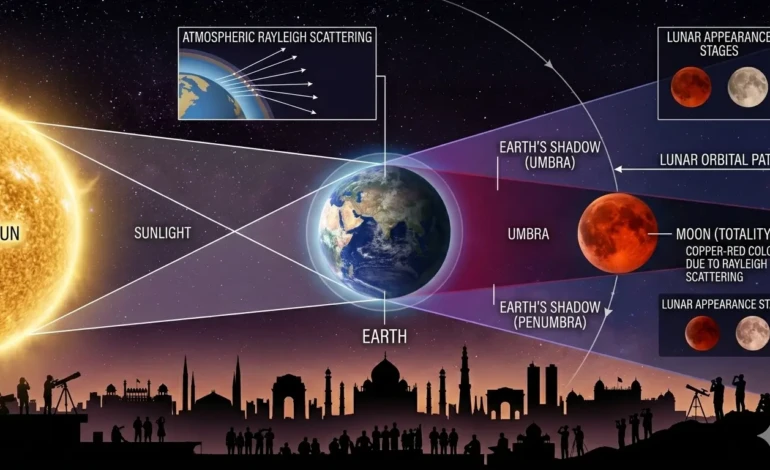
A lunar eclipse — called Chandra Grahan in Hindi — is a spectacular celestial event that occurs when the Earth comes directly between the Sun and the Moon. Earth’s shadow falls across the lunar surface, temporarily darkening or changing the Moon’s color. Unlike a solar eclipse, no special glasses are needed — it is completely safe to watch with the naked eye!
There are three types of lunar eclipses:
Total Lunar Eclipse
Moon passes completely into Earth’s umbra (darkest shadow). Appears deep red — the “Blood Moon.”
Partial Lunar Eclipse
Only part of the Moon enters Earth’s umbra. Part of the Moon looks darker than usual.
Penumbral Eclipse
Moon passes through Earth’s outer shadow (penumbra). Very subtle dimming — hard to notice.
🔭 Lunar Eclipse 2026 — Key Details
Today’s lunar eclipse is a Total Lunar Eclipse — the most dramatic kind. Here’s a quick summary of what makes this event extra special:
✅ Last total lunar eclipse until December 31, 2028
✅ Coincides with Holi (Holika Dahan) in India
✅ Also falls on the Lantern Festival (first time since 2017)
✅ Totality lasts approximately 58 minutes
✅ Moon will be in the constellation Leo
| Event Detail | Information |
|---|---|
| 📅 Date | March 3, 2026 (Tuesday) |
| 🌍 Type | Total Lunar Eclipse (Blood Moon) |
| ⏱️ Totality Duration | ~58 minutes |
| 🕐 Greatest Eclipse (UTC) | 11:33 AM UTC |
| 🌏 Visible From | Asia, Australia, Pacific, North America, parts of Europe & South America |
| 🌙 Moon’s Constellation | Leo (the Lion) |
| 🎉 Coincides With | Holi / Holika Dahan (India), Lantern Festival |
| ⏳ Next Total Lunar Eclipse | December 31, 2028 |
🇮🇳 India Timings & City-wise Visibility
India sees varying levels of visibility depending on location. The northeastern states will see the best view, including the Blood Moon’s deep red phase, while cities in western and central India will catch only the partial or final stages after moonrise.
Eclipse Begins: 3:20 PM IST | Best Viewing Window: 6:33 PM – 6:40 PM IST | Eclipse Ends: 6:47 PM IST
Sutak Kaal Started: 6:23 AM IST
| City / Region | Visibility | View Window (IST) | What You See |
|---|---|---|---|
| 🏆 Guwahati, Dibrugarh (Assam) | ✅ Best | From moonrise onward | Full totality — deep red Blood Moon |
| 🏆 Arunachal Pradesh (Itanagar) | ✅ Excellent | From moonrise onward | Full totality — Blood Moon |
| 🥈 Kolkata, Patna, Bhubaneswar | ✅ Good | ~6:15 – 6:47 PM | Large partial phase, near-totality |
| 🥉 Delhi, Lucknow, Jaipur | 🟡 Partial | ~6:20 – 6:47 PM | Final partial/penumbral phases |
| 🥉 Mumbai, Pune, Ahmedabad | 🟡 Partial | ~6:25 – 6:47 PM | End of partial phases only |
| 🥉 Chennai, Bengaluru, Hyderabad | 🟡 Partial | ~6:20 – 6:47 PM | End of partial phases only |
| Extreme West (Gujarat, Rajasthan borders) | 🔴 Very Limited | ~6:35 – 6:47 PM | Very brief penumbral phase |
🕉️ Sutak Kaal — What It Means
In Indian tradition, a period called Sutak Kaal is observed before and during a lunar eclipse. It is considered an inauspicious period where certain activities are traditionally avoided.
• Sutak for this eclipse: 6:23 AM to 6:47 PM IST on March 3
• Temple doors are generally kept closed
• New cooking and eating during eclipse is often avoided; Tulsi leaves placed in food/water
• Auspicious ceremonies (weddings, engagements) are postponed
• After eclipse ends: ritual bath and donation to the needy is customary
🔬 Science Behind the Blood Moon — Why Does It Turn Red?
This is one of the most fascinating questions in astronomy, and it connects directly to what students learn in school about light, atmosphere, and the solar system.
When the Earth’s shadow falls completely on the Moon during totality, the Moon doesn’t simply go dark. Sunlight passing through Earth’s atmosphere bends (refracts) around the Earth and reaches the Moon. Earth’s atmosphere filters out most blue light, allowing only red and orange wavelengths to pass through — the same reason we see red and orange sunrises and sunsets. All the world’s sunrises and sunsets are effectively projected onto the Moon at once, giving it that stunning blood-red glow!
🔴 Rayleigh Scattering — Why blue light scatters and red light passes
🌍 Earth’s Atmosphere — Acts as a lens bending light around the planet
☀️ Solar System Geometry — Sun, Earth, Moon in perfect alignment
🌑 Umbra & Penumbra — Types of shadows in space
📡 Astronomical Observation — How scientists measure and predict eclipses
👁️ How to Watch Lunar Eclipse 2026 — Tips for Students & Families
No Equipment Needed
Lunar eclipses are completely safe for naked-eye viewing. No glasses, filters, or telescopes required!
Find an Open Eastern Sky
By 6:20 PM IST, look east for the rising Moon. Find a rooftop or open ground away from buildings.
Photography Tips
Use a smartphone on a tripod. Night mode with manual exposure works great for capturing the red Moon.
Watch Online
If weather is cloudy, NASA and TimeAndDate.com are streaming the eclipse live online. Free!
⚖️ Solar Eclipse vs Lunar Eclipse — Comparison Table
Students often confuse solar and lunar eclipses. Here’s a clear comparison to help you remember the difference for your exams and general knowledge:
| Feature | 🌑 Lunar Eclipse (Chandra Grahan) | ☀️ Solar Eclipse (Surya Grahan) |
|---|---|---|
| Who is blocked? | Sunlight reaching the Moon | Sunlight reaching the Earth |
| Position | Sun → Earth → Moon | Sun → Moon → Earth |
| When does it occur? | Full Moon (Purnima) | New Moon (Amavasya) |
| Safe to see? | ✅ Yes, naked eye safe | ❌ No, special eclipse glasses needed |
| Duration | Several hours (totality ~1 hr) | A few minutes (totality 2–7 min) |
| Visibility Area | Entire night side of Earth | Narrow path on Earth’s surface |
| Moon/Sun appearance | Moon turns dark red / copper | Sun covered by Moon’s disc |
| Frequency | 2–4 times a year | 2–5 times a year |
| Sutak Kaal (Indian tradition) | 9 hours before eclipse | 12 hours before eclipse |
🌍 Real-Life Connections for Students
Eclipses aren’t just beautiful — they have shaped human history, science, and culture in profound ways. Here are some real-life examples that every student should know:
🌐 Useful External Resources
🚀 NASA Official
NASA’s detailed guide to the March 2026 total lunar eclipse with maps and visualizations.
Visit NASA ↗⏱️ TimeAndDate.com
Interactive eclipse map with accurate local timings for every city in India and the world.
View Timings ↗🔭 TheSkyLive
Detailed eclipse timeline and interactive animation showing the Moon moving through Earth’s shadow.
Explore ↗❓ Frequently Asked Questions (FAQ)
🌕 Final Words
The Lunar Eclipse 2026 — Chandra Grahan — is one of the most special astronomical events of this decade. Falling on the festive night of Holi, it brings together science, culture, and nature in a truly unforgettable way. Whether you’re a student curious about how the universe works, a parent sharing a stargazing moment with your children, or a teacher looking to bring classroom concepts alive — tonight’s Blood Moon is for you.
Step outside, look east, and witness the moment when all of Earth’s sunrises and sunsets paint the Moon red. 🌑🔴🌕
— Shailendra Porwal, StudyReach.in | Empowering learners, one article at a time.