CBSE on-screen marking (OSM) 2026: Complete Guide to Online Scanning and Marking for Class 12 Board Exams

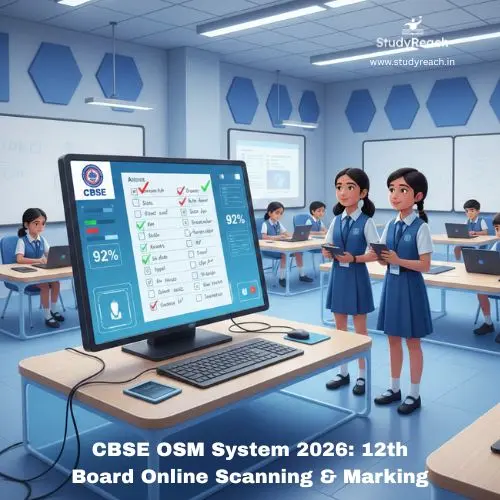
Gone are the days of bulky answer-sheet bundles and manual evaluation delays. Through CBSE on-screen marking (OSM) it has introduced a secure, technology-driven system that makes Class 12 board exam assessment more transparent, reliable, and efficient than ever before.
🚨 Breaking News for Class 12 Students!
CBSE on-screen marking (OSM) is here! Over 17 lakh students will have their answer sheets evaluated digitally in 2026. This complete guide explains everything you need to know.
📑 Table of Contents
- What is CBSE CBSE on-screen marking (OSM)?
- Key Features of the OSM System 2026
- How Will OSM Work for Class 12 Students?
- Benefits of Online Scanning and Marking
- 7-Step OSM Process Explained
- Schools Preparation for OSM Implementation
- What Students and Parents Should Know
- FAQs About CBSE OSM System
Introduction
CBSE on-screen marking (OSM) is revolutionizing how board exams are evaluated in 2026. The Central Board of Secondary Education (CBSE) has announced a major digital transformation by introducing the Online Scanning and Marking (OSM) system for Class 12 board examinations. This year, over 17 lakh students’ answer sheets—approximately 1 crore copies—will be scanned and evaluated digitally, involving an investment of ₹32 crore.
If you’re a Class 12 student, parent, or educator, understanding this new system is crucial as it will directly impact how answer sheets are evaluated, ensuring more transparency and efficiency in the examination process.
CBSE on-screen marking (OSM)2026 – Quick Facts
What is CBSE OSM System?
The CBSE on-screen marking (OSM) System is a digital evaluation method where students’ answer sheets are scanned and uploaded to a centralized computer system. Teachers then evaluate these digital copies online instead of checking physical paper copies.
This marks a significant shift from the traditional pen-and-paper evaluation method to a completely digital assessment process, similar to systems already used in competitive exams like JEE and NEET.
Why is CBSE Implementing OSM?
- Transparency: Digital records reduce chances of answer sheet misplacement
- Efficiency: Faster evaluation and result declaration
- Accuracy: Multiple quality checks possible
- Security: Better protection against copying and evaluation errors
- Modernization: Aligning with digital India initiatives
Key Features of the OSM System 2026
According to the latest CBSE circular, here are the standout features of the CBSE OSM System for 2026:
- Scale: Over 1 crore answer sheets from 17 lakh+ students will be digitized
- Investment: ₹32 crore project for complete digitalization
- Coverage: All Class 12 students appearing from February 17 to April 10, 2026
- Method: Every answer sheet will be scanned using digital scanning systems
- Evaluation: Teachers will mark answers on computer screens
- Schools: Approximately 32,000 schools need to prepare their infrastructure
How Will OSM Work for Class 12 Students?
Students will NOT see any difference in how they write their exams. The OSM system affects only the evaluation process. Here’s what remains the same:
- Students write exams on physical OMR/answer sheets
- Same exam pattern and question paper format
- Same exam centers and timings
- Same syllabus and marking scheme
💡 Important Note
The only change happens after you submit your answer sheet—it gets scanned and sent digitally to evaluators instead of being physically transported.
Benefits of Online Scanning and Marking
For Students:
- Faster Results: Digital evaluation speeds up the entire process
- Better Accuracy: Multiple checks reduce human errors
- Transparent Process: Digital trail of evaluation
- Secure Handling: No risk of answer sheets getting lost or damaged
- Fair Evaluation: Reduced bias as evaluators may not know student identity
For Teachers:
- Flexible Timing: Evaluate from anywhere, anytime
- Better Tools: Digital marking tools for precision
- Quality Control: Automatic monitoring systems
- Reduced Physical Burden: No need to transport heavy answer bundles
For Education System:
- Data Analytics: Better understanding of student performance patterns
- Resource Optimization: Efficient use of evaluator time
- Environmental Impact: Reduced paper handling and transportation
- Scalability: Easy to manage large number of students
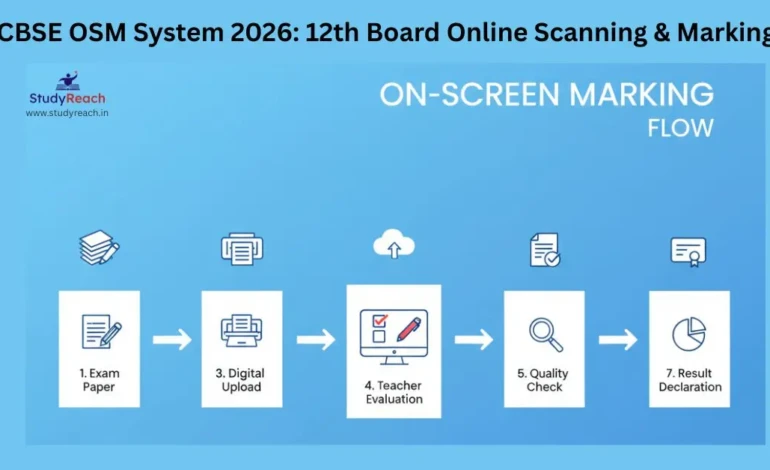
7-Step OSM Process Explained
Understanding the complete evaluation journey helps reduce anxiety. Here’s the detailed CBSE OSM System workflow:
Step 1: Exam Center Preparation
- Students write answers on specially designed answer sheets
- The answer sheet format remains similar to previous years
- OMR-friendly sheets with proper coding
Step 2: Answer Sheet Collection
- After exam completion, answer sheets collected as usual
- Transported to designated scanning centers
- Different answer sheets scanned differently (40 pages, 32 pages, 20 pages copies)
Step 3: Digital Scanning
- High-quality scanning centers scan every page
- Answer sheets converted to digital format
- Uploaded to CBSE’s central computer system
- Each student’s identity kept confidential during evaluation
Step 4: Allocation to Evaluators
- System assigns digital copies to qualified teachers
- Subject-specific allocation
- Teachers access copies through secure login
- No indication of student name or roll number shown
Step 5: Online Evaluation
- Teachers evaluate on computer screens
- Digital marking tools used for scoring
- Marks entered directly into the system
- Real-time progress tracking
Step 6: Quality Check & Verification
- Some copies randomly selected for re-evaluation
- Senior teachers verify marking quality
- Automatic alerts for unusual marking patterns
- Ensures consistency across evaluators
Step 7: Result Processing
- Marks compiled automatically
- Cross-verification with school records
- Final result preparation
- Declaration on official CBSE website
Schools Preparation for OSM Implementation
CBSE has directed approximately 32,000 schools to prepare for the OSM system:
Infrastructure Requirements:
- Computer Labs: Schools must ensure updated computer systems
- Internet Connectivity: High-speed stable internet required
- Teacher Training: Educators to be trained on digital evaluation
- Practice Sessions: Mock evaluations before actual implementation
Training Phases:
- Pre-exam: Teachers learn the OSM interface
- Mock Evaluation: Practice with sample answer sheets
- Orientation: Understanding marking guidelines digitally
- Support System: Technical help desk during evaluation
What Students and Parents Should Know
Important Points for Students:
- Writing Style Matters: Write clearly and legibly as your sheet will be scanned
- No Change in Preparation: Study pattern remains exactly the same
- Follow Instructions: Use only blue/black pen as instructed
- Fill OMR Carefully: Proper coding ensures correct digitization
- Neat Presentation: Better scan quality helps evaluators
For Parents:
- This is a positive change bringing more transparency
- No extra cost or burden on students
- Results may come faster than previous years
- Digital record means better grievance handling if needed
- Trust the system—it’s designed for fairness
Common Concerns Addressed:
Q: Will computer evaluation miss partial marks?
A: No, teachers still evaluate manually on screen, not AI
Q: What if scanning quality is poor?
A: Multiple quality checks ensure readable scans
Q: Can we still apply for re-evaluation?
A: Yes, re-evaluation process continues as before
🎯 Key Takeaways
The CBSE OSM System represents a major leap toward digital education assessment. While the change might seem overwhelming, remember:
- Your exam experience remains unchanged
- Only the evaluation method is digitized
- More transparency and efficiency
- Faster result declaration expected
- Better security of answer sheets
- Reduced human errors in marking
Focus on your preparation, write clearly, and trust the new system designed to make evaluation fairer and faster.
FAQs About CBSE OSM System
🔵Introduction of On-Screen Marking (0SM) for Class XII
International English Language Testing System
- The Central Board of Secondary Education (CBSE) conducts Class X and Class XII Board examinations annually in India and across 26 countries, catering to nearly 46 lakh students. In its continuous effort to enhance efficiency and transparency, the Board has decided to introduce On-Screen Marking (0SM) for the evaluation of Class XIl answer books beginning with the 2026 examinations. Evaluation ……

✍️ About the Author
Shailendra Porwal, Founder of www.StudyReach.in, is an experienced education professional and content strategist. With years of work in school leadership and student guidance, he writes to simplify educational updates for students, parents, and teachers.
StudyReach.in brings you timely information about CBSE circulars, scholarship programs, and career guidance to help students excel academically. Stay updated.
Recent Posts
 Private vs Government College – Which is Better?
- Class X CBSE Result – What Next ?
- CBSE vs ICSE
- Drop or Repeater
- Allen Kota
- RBSE 10th Result 2026 OUT: Direct Link & Toppers List
- CBSE Foundational Learning Study 2026 – FLS
- Gender Gap in Learning 2026:Boys vs. Girls in STEM & Literacy
- Cell Phone Ban in Schools ! What Do You Think
- CBSE Class X Second Board Examination 2026 – LOC Guide