Essential Life Skills

Beyond Grades: What Should Schools Teach Children for the Real World?
Good grades may open doors, but practical skills help children walk through them. Are our schools preparing students for examinations alone, or for the challenges of everyday life?
A student may score excellent marks in mathematics but struggle to manage a monthly budget. Another may write a brilliant essay but find it difficult to express an opinion in a group discussion. Are these students fully prepared for life beyond school?
📋 Table of Contents
- The Purpose of Education: Beyond Marks and Certificates
- The Changing Expectations of Education
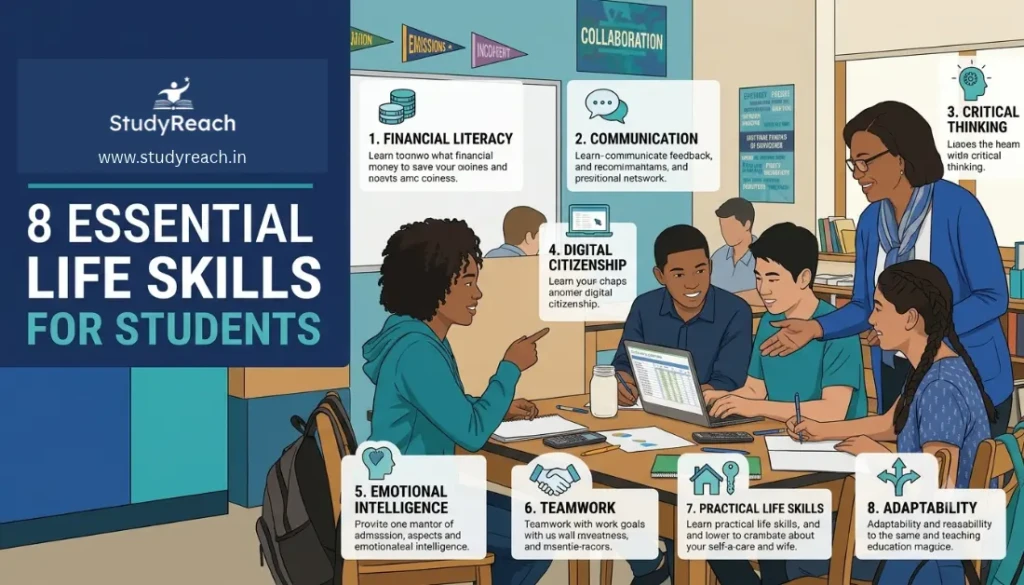
- Eight Essential Life Skills Every Student Should Learn
- What Should Students Learn at Different School Stages?
- How Can Schools Make Life Skills Part of Everyday Learning?
- What Role Should Teachers Play?
- What Can Parents Do at Home?
- How Can Schools Assess Life Skills?
- A Simple Life Skills Project Every School Can Start
- Frequently Asked Questions
- Final Words
- Sources and Further Reading
Imagine a young person completing school with excellent grades, a university admission letter and a long list of academic achievements.
Now imagine that same young person facing a few ordinary situations:
- How should I manage my first salary?
- How do I recognise an online scam?
- How should I handle a disagreement with a colleague?
- How do I make an important decision when nobody is there to guide me?
- What should I do when a plan fails?
These are not examination questions. Yet they are part of everyday adult life.
Our schools teach mathematics, science, languages, history and many other important subjects. These provide the foundation for knowledge and future opportunities. But is subject knowledge alone enough?
In a world shaped by technology, changing careers, financial responsibilities and complex human relationships, children also need the ability to apply what they know.
- Why academic achievement alone is not enough
- Eight essential life skills every student should develop
- What schools can teach through practical activities
- How parents can reinforce these skills at home
- How to connect classroom learning with real-world situations
1. The Purpose of Education: Beyond Marks and Certificates
For generations, academic results have played an important role in a student’s educational journey. Marks influence admissions, scholarships, course choices and career opportunities. We should not underestimate their value.
But should marks be the only measure of a child’s readiness for the future?
Consider two students. One consistently scores high marks but struggles to work with others, manage time or make independent decisions. The other performs well academically and can also communicate, solve problems, manage responsibilities and adapt to new situations.
Which student is better prepared to face the variety of challenges that adult life may bring?
The answer is not that academics are unimportant. Rather, education should help students connect academic knowledge with practical abilities.
A science lesson can teach students about energy conservation. A practical activity can ask them to identify how their school or home could reduce electricity consumption.
A mathematics lesson can teach percentages. A financial literacy activity can help students understand discounts, savings and interest.
An English lesson can develop writing skills. A presentation can help students communicate an idea confidently.
The real opportunity is to make learning useful beyond the classroom.

2. The Changing Expectations of Education
Education systems around the world are increasingly discussing skills that go beyond traditional subject knowledge.
McGraw Hill’s 2026 Global Education Insights report asked educators about priorities for preparing students. Among the leading priorities were:
| Skill or learning priority | Educators identifying it as a priority |
|---|---|
| Critical thinking and problem-solving | 95% |
| Real-world, applied learning experiences | 95% |
| Career exploration and vocational guidance | 93% |
| Communication and collaboration | 91% |
| Financial literacy | 91% |
Source: McGraw Hill, Global Education Insights 2026. Figures reflect surveyed educators’ identified priorities.
These findings suggest that educators see practical learning as an important part of preparing students for the future.
So, what should these skills look like in a school? Here are eight areas worth giving serious attention.
3. Eight Essential Life Skills Every Student Should Learn
Financial Literacy – Understanding How Money Works
Most students learn mathematics, including addition, subtraction, percentages and sometimes interest. But do they understand how to apply these concepts when handling money?
Imagine a young adult receiving their first monthly salary. They need to pay for accommodation, food, transportation, bills and other expenses. They may also want to save for a future goal.
Without basic financial knowledge, even a reasonable income can become difficult to manage.
Students should gradually learn:
- Difference between needs and wants
- How to prepare a simple budget
- Saving and setting financial goals
- Understanding bank accounts and digital payments
- Basic concepts of interest, borrowing and debt
- Recognising financial fraud, scams and misleading offers
- Understanding responsible spending and the value of money
Give students a fictional monthly budget. Ask them to allocate money for food, transport, savings, bills and entertainment. Then introduce an unexpected expense and ask them to revise their budget.
Learning outcome: Planning, prioritising and responsible decision-making.
This is not about teaching children to become financial experts. It is about helping them make informed decisions when they begin managing their own money.
The importance of this subject is reflected in recent US education policy. New York State adopted a K–12 personal finance education requirement in March 2026, while Texas has introduced updated personal financial literacy graduation requirements for students entering Grade 9 in the 2026–27 school year.
Sources: New York State Education Department and Texas Education Agency.
Communication – Expressing Thoughts with Confidence
Can a student explain an idea clearly? Can they ask a question without fear? Can they listen when someone disagrees?
Communication is much more than speaking fluent English or giving a speech on stage.
It includes listening, writing, asking questions, explaining ideas, understanding different viewpoints and communicating respectfully.
Students should practise:
- Speaking confidently in front of a group
- Listening without interrupting
- Writing clear emails and messages
- Participating in discussions and debates
- Expressing disagreement respectfully
- Asking for help or clarification when needed
Ask every student to explain a familiar topic in two minutes. Other students must listen and ask one meaningful question. Rotate the speaker’s role so that every child gets an opportunity.
Learning outcome: Confidence, listening, clarity and respectful interaction.
A child who can communicate effectively is better equipped to participate in discussions, seek support, build relationships and express ideas in many different settings.
Critical Thinking and Problem-Solving
In everyday life, problems rarely arrive in the form of a textbook question with four options.
A student may face a difficult group project, a disagreement with a friend, a confusing online message or an unexpected change in plans.
Should they react immediately? Follow what everyone else is doing? Or pause, understand the situation and consider possible solutions?
Schools can help students develop the habit of thinking before deciding.
Students should learn to:
- Identify the actual problem
- Separate facts from assumptions
- Ask relevant questions
- Compare different possible solutions
- Consider the consequences of a decision
- Learn from mistakes and try again
Present a situation: The school wants to reduce plastic waste. Ask groups to investigate the problem, suggest practical solutions, estimate costs and present their recommendations.
Learning outcome: Analysis, teamwork, creativity and decision-making.
OECD’s PISA 2025 report also highlights the importance of evaluating information, connecting ideas from different sources and thinking critically about what students read.
Digital Citizenship – Being Safe and Responsible Online
Today’s students do not simply use technology. They live, learn, communicate and increasingly work in digital environments.
But does every student know how to identify misleading information, protect personal data or behave responsibly online?
Digital citizenship means understanding both the opportunities and responsibilities that come with using technology.
Students should learn:
- How to recognise unreliable information and misinformation
- How to protect passwords and personal information
- How to identify online scams and suspicious links
- Why cyberbullying and online harassment are harmful
- How to respect copyright and acknowledge sources
- How to use artificial intelligence responsibly
- How online actions can affect privacy and reputation
Show students two sample online news posts about the same topic. Ask them to check the author, date, evidence and original source before deciding which information is trustworthy.
Learning outcome: Media literacy, online safety and responsible judgement.
The OECD’s PISA 2025 findings underline why this matters: only 46% of students across OECD countries reported both checking the credibility of information sources and placing greater trust in scientific evidence than in common sense.
Students need more than access to information. They need the ability to judge it.
UNESCO also emphasises digital citizenship, critical thinking, empathy and responsible participation in an increasingly connected world.
Emotional Intelligence – Understanding Yourself and Others
Academic life can bring competition, pressure, disappointment and uncertainty. Students may struggle with examination results, friendships, expectations or fear of failure.
Can a child recognise frustration before reacting? Can they accept criticism? Can they understand how another person feels?
Emotional intelligence is not about being happy all the time. It is about recognising emotions, managing reactions, understanding others and developing healthy relationships.
Students should practise:
- Recognising and expressing emotions appropriately
- Managing frustration and disappointment
- Developing empathy
- Respecting differences
- Handling disagreements constructively
- Asking for support when they need it
Present a situation where two classmates disagree during a team activity. Ask students to describe how each person might feel and suggest a fair way to resolve the disagreement.
Learning outcome: Empathy, self-awareness and conflict resolution.
OECD research on social and emotional learning highlights skills such as empathy, emotional control, cooperation and self-efficacy. These should not be treated as optional extras in education.
Collaboration and Teamwork
Most real-world achievements involve working with other people. Whether students enter a university, start a business, join a workplace or participate in community activities, they will need to cooperate with people who may think differently from them.
Teamwork is not simply sitting together and dividing the work. It requires responsibility, trust, listening, sharing ideas and respecting contributions.
Students should learn to:
- Share responsibilities fairly
- Respect different opinions
- Support team members
- Resolve disagreements
- Accept responsibility for their contribution
- Celebrate shared success
Give students a limited budget and ask them to plan a small school event. They must assign roles, prepare a schedule, manage expenses and present the final plan.
This teaches more than teamwork. It also develops planning, communication, budgeting and accountability.
Practical Life Skills – Becoming Independent
How many students know how to organise their documents, read a basic bill, prepare a simple meal or follow a schedule?
These may sound like ordinary activities, but independence is developed through practice.
Schools can introduce age-appropriate activities that help children become responsible for themselves and their surroundings.
Examples include:
- Time management and planning a daily routine
- Personal hygiene and basic health awareness
- Understanding household responsibilities
- Basic first-aid awareness and knowing when to seek help
- Reading forms, instructions and simple official documents
- Understanding public transport and road safety
- Environmental responsibility and waste management
Organise a “Life Skills Day”. Students rotate through stations involving first-aid awareness, reading a timetable, sorting household waste, planning a simple meal and organising a personal schedule.
Learning outcome: Independence, responsibility and practical awareness.
The purpose is not to turn schools into training centres for every household task. It is to give students safe opportunities to practise the responsibilities they will gradually encounter in life.
Adaptability, Creativity and Lifelong Learning
The world students enter after school may look very different from the world they know today.
New technologies will emerge. Careers will change. Some jobs may disappear, while new opportunities will develop. People may need to learn new skills several times during their working lives.
Can schools prepare children for a future that nobody can predict completely?
They can begin by helping students become curious, adaptable and willing to learn throughout life.
Students should practise:
- Trying new approaches when an old method fails
- Learning from feedback
- Exploring creative solutions
- Setting personal learning goals
- Using technology as a tool rather than depending on it blindly
- Accepting that learning continues beyond examinations
Ask students to identify a problem in their school or community and design a simple solution. They can create a model, poster, presentation or prototype and explain how they would improve it after receiving feedback.
This builds curiosity, initiative, creativity and confidence.
4. What Should Students Learn at Different School Stages?
Life skills should not be introduced as a single subject only in the final year of school. They should develop gradually, with activities appropriate to the age and maturity of the child.
| School stage | Skills to emphasise | Example activity |
|---|---|---|
| Early years and elementary | Sharing, communication, hygiene, emotional awareness, basic money concepts | Classroom responsibilities, pretend shop, storytelling |
| Middle school | Teamwork, budgeting basics, digital safety, problem-solving, time management | Group projects, simple budgets, online fact-checking |
| High school | Personal finance, career awareness, decision-making, communication, independent living | Mock interviews, monthly budget projects, career research |
These are suggested learning priorities, not a universal curriculum. Schools should adapt them to students’ developmental needs, local contexts and national or state requirements.
5. How Can Schools Make Life Skills Part of Everyday Learning?
One challenge is that school timetables are already full. Teachers have syllabuses to complete, examinations to prepare for and learning outcomes to achieve.
Does teaching life skills mean adding another heavy subject to an already crowded curriculum?
Not necessarily.
Many life skills can be developed through existing subjects and school activities.
- Mathematics: Teach percentages through discounts, budgets and simple interest.
- English and languages: Develop communication through presentations, interviews and discussions.
- Science: Connect scientific concepts with health, environment and everyday problem-solving.
- Social studies: Explore citizenship, rights, responsibilities and community issues.
- Computer education: Include digital safety, privacy, source verification and responsible AI use.
- Sports and activities: Develop teamwork, discipline, resilience and respect.
- Clubs and projects: Encourage creativity, leadership, planning and collaboration.
Schools can also introduce one practical learning period every week or organise monthly life-skills projects. The key is consistency rather than a one-day event.
6. What Role Should Teachers Play?
Teachers are not expected to have every answer to every real-world challenge. Their role is to create opportunities in which students can ask questions, practise skills, make decisions and learn from experience.
A teacher can develop communication through classroom discussions, problem-solving through open-ended questions and responsibility through group assignments.
Most importantly, teachers can model the behaviour they want students to develop: fairness, respect, curiosity, patience and a willingness to keep learning.
Professional development also matters. Teachers need resources, time and support to design practical learning activities and assess skills fairly.
7. What Can Parents Do at Home?
Schools play an important role, but children learn practical behaviour through everyday family life as well.
Parents do not need expensive courses or special equipment to develop life skills. Many opportunities already exist at home.
- Let children take age-appropriate decisions about their daily routine.
- Involve them in shopping and compare prices together.
- Discuss needs, wants and saving for a goal.
- Encourage them to express opinions respectfully.
- Allow them to solve small problems instead of immediately providing every answer.
- Give them reasonable household responsibilities.
- Talk openly about online safety and responsible technology use.
- Appreciate effort, improvement and responsibility—not only marks.
There is a difference between protecting children from every difficulty and preparing them to handle difficulties safely.
Sometimes, allowing a child to make a small mistake and learn from it is more valuable than correcting everything on their behalf.
8. How Can Schools Assess Life Skills?
This is an important question. If schools say that communication, teamwork, responsibility and problem-solving matter, how can they make sure these skills are actually developing?
Not every life skill can be measured through a written examination. Schools can use a combination of observations and practical evidence.
- Project work: Can students plan and complete a task?
- Presentations: Can they explain their ideas clearly?
- Group activities: Can they cooperate and share responsibilities?
- Reflection journals: Can they identify what they learned and what they would improve?
- Practical demonstrations: Can they apply knowledge to a real situation?
- Self and peer assessment: Can they reflect on their contribution and learn from feedback?
Assessment should focus on development, not labelling a child as good or bad at a personal skill. Students need room to practise and improve.
9. A Simple Life Skills Project Every School Can Start
Schools do not need to redesign their entire curriculum to begin. A small, well-planned project can make a meaningful start.
The Real-World Ready Challenge
Such projects can be adapted for different age groups and school resources. They also create opportunities for teachers, parents and students to work together.
Frequently Asked Questions
Final Words: Let Us Prepare Children for Life, Not Just Examinations
Education should open doors, develop abilities and give young people the confidence to face an uncertain future.
Good marks matter. Subject knowledge matters. Qualifications and academic opportunities matter too.
But a child’s education should not end with a report card.
When students leave school, they should be able to think independently, communicate clearly, manage responsibilities, understand money, use technology wisely, work with others and learn from setbacks.
These abilities are not separate from education. They are an essential part of becoming a capable and responsible adult.
Schools cannot prepare children for every situation they will encounter. But they can give them the knowledge, habits and confidence to face new situations thoughtfully.
So perhaps the question every school should ask is not only, “How well did our students score this year?”
It should also be:
Are our students ready for life beyond the classroom?
Because the real success of education is not just what children remember for an examination, but what they can understand, apply and contribute throughout their lives.
Sources and Further Reading
Global Education Insights 2026
PISA 2025 Results: Future-Ready Students
Personal Finance Education
Personal Financial Literacy Graduation Requirements
Education for Just and Democratic Societies
Reimagining Teaching in an Accelerating World