
Har Ghar Tiranga

Har Ghar Tiranga 2026: Why the Tiranga Means More Than a Flag
Every year, as Independence Day approaches, something changes across India. Homes begin to display the Tiranga. Schools prepare special assemblies. Children practise patriotic songs. Communities organise rallies and cultural programmes.
But there is a question worth asking: Are we simply displaying the flag, or are we also helping the next generation understand what the flag represents?
That is what makes Har Ghar Tiranga 2026 more than just another Independence Day activity.
The Har Ghar Tiranga campaign was launched in 2022 under the aegis of Azadi Ka Amrit Mahotsav. Over the years, it has grown into a large public participation movement encouraging citizens to bring the National Flag into their homes and express their connection with the nation.
For 2026, the campaign is being observed from 9 August to 17 August, with participation encouraged not only across India but also among Indian communities abroad. Citizens are being encouraged to display the Tiranga and participate in the “Selfie with Tiranga” initiative.
For students, however, the campaign can mean something much deeper.
What Is Har Ghar Tiranga?
The words are simple: Har Ghar Tiranga — the Tiranga in every home.
But the idea behind the campaign is larger than putting a flag on a balcony, terrace or entrance.
It is about creating a personal connection between citizens and the National Flag — a symbol that represents India’s freedom, unity, democratic values and national identity.
The campaign began in 2022 and has continued to grow as a people-participation movement. The Ministry of Culture has described it as an initiative that encourages citizens to bring the Tiranga into their homes and celebrate the spirit of independence.
The 2025 edition saw enormous participation, including 7.50 crore selfies with the National Flag and more than 9 lakh Tiranga volunteers.
🇮🇳 The real idea behind Har Ghar Tiranga
The campaign is not only about seeing more flags.
It is about helping more people understand why the flag matters.
And for children, that understanding can become a lesson in history, responsibility, unity and citizenship.
Har Ghar Tiranga 2026: Important Dates
| Activity | 2026 Information |
|---|---|
| Campaign Period | 9 August to 17 August 2026 |
| Independence Day | 15 August 2026 |
| Selfie with Tiranga | Citizens are encouraged to display the National Flag and participate through the official Har Ghar Tiranga portal. |
| National Flag Quiz | MY Bharat’s National Flag of India Quiz 2026 is open until 15 August. |
| Indian Community Abroad | Indian communities outside India are also encouraged to participate. |
The Government’s 2026 campaign also includes youth-oriented participation. MY Bharat has launched the National Flag of India Quiz 2026, designed to help young citizens learn about the history, evolution, significance and dignity of the National Flag.
Why Should Students Care About Har Ghar Tiranga?
This is perhaps the most important part of the discussion.
For a young student, patriotism should not be limited to wearing a tricolour badge for one day or participating in a school assembly.
It should gradually become an understanding of what it means to be a responsible citizen.
The Tiranga can open conversations about India’s freedom struggle, the Constitution, democratic values, diversity, sacrifice and the responsibilities that come with freedom.
📚 History
Students can explore the freedom movement and understand how generations of Indians contributed to the struggle for independence.
🤝 Unity
The same National Flag is displayed by people across different languages, religions, regions and cultures.
🫡 Responsibility
Students can learn that citizenship is not only about rights. It also involves duties, respect and responsible behaviour.
🌱 Nation Building
Young people can connect patriotism with education, cleanliness, honesty, service, innovation and contributing positively to society.
The Tiranga Is a Lesson in Responsible Citizenship
Sometimes schools talk about patriotism only during August and January.
But citizenship should not be seasonal.
A student who respects the National Flag should also learn to respect public property.
A student who feels proud of the country should also care about keeping the surroundings clean.
A student who celebrates freedom should understand the importance of respecting the freedom and dignity of others.
This is where Har Ghar Tiranga 2026 can become an educational opportunity rather than just a ceremonial activity.
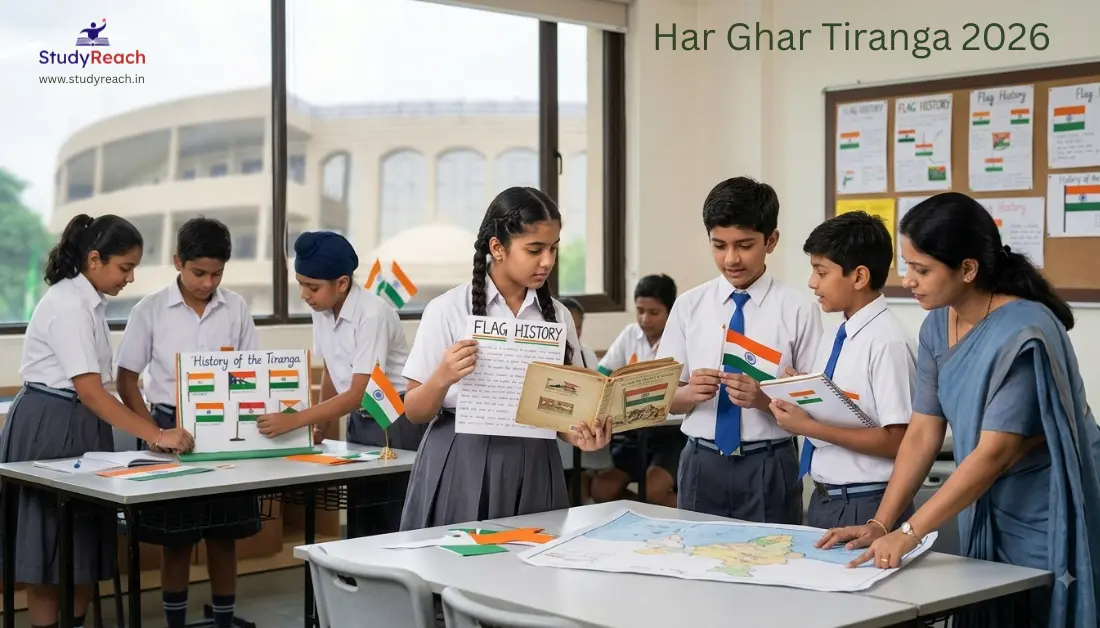
How Can Schools Make Har Ghar Tiranga Meaningful?
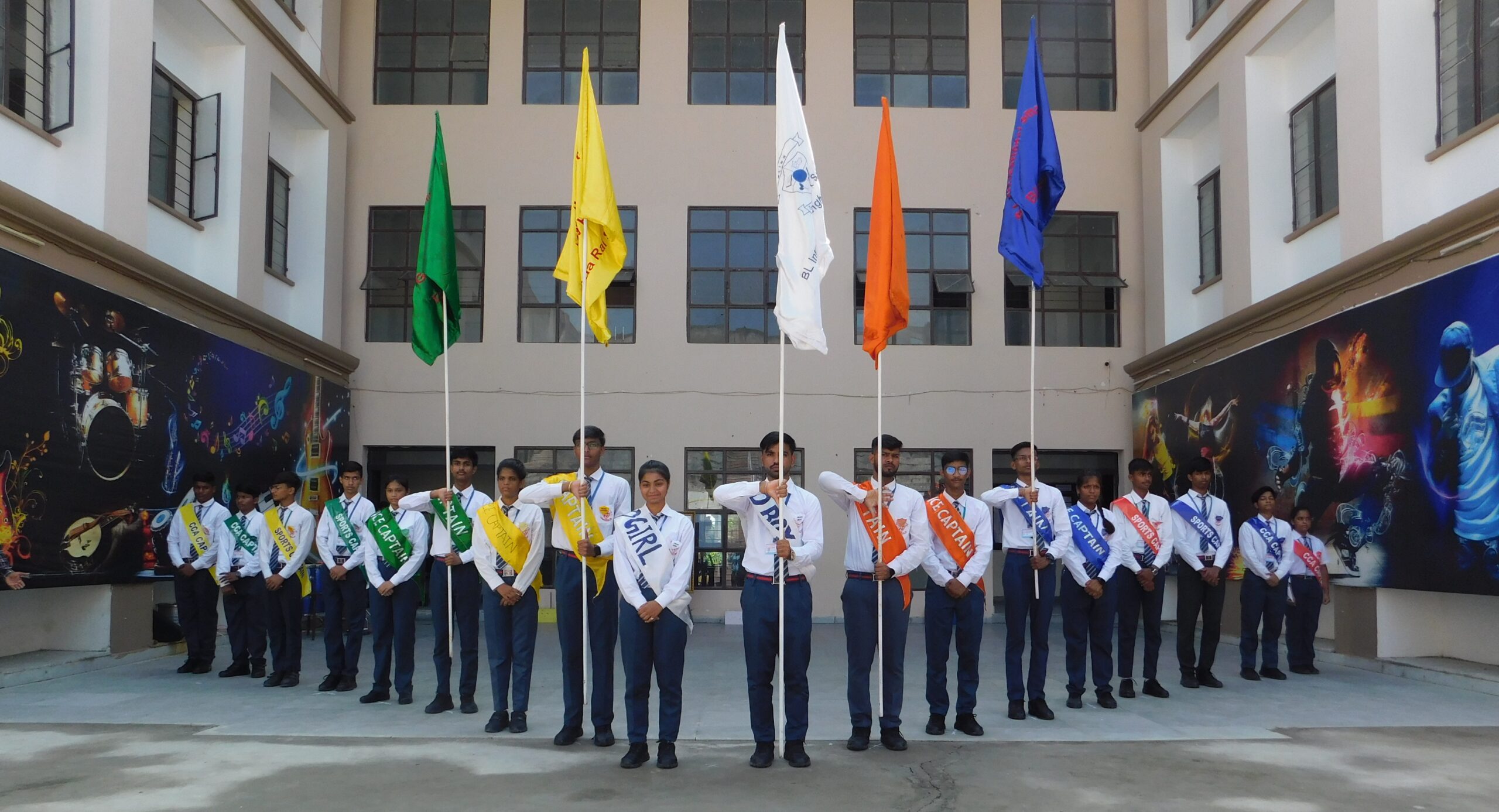
Schools have a special role in this campaign because children do not simply participate in school activities — they often take the message home.
Instead of limiting the celebration to flag hoisting, schools can design activities that help students understand the story behind the flag.
1 Tiranga Storytelling
Ask students to research and present short stories connected with India’s freedom struggle and the National Flag.
Younger children can narrate simple stories, while senior students can conduct research-based presentations.
2 National Flag Quiz
A school-level quiz can cover the history of the Indian National Flag, important milestones, the freedom movement and the values associated with it.
Schools can also encourage eligible students to explore the official MY Bharat National Flag Quiz 2026.
3 Letter to a Soldier
Students can write letters expressing gratitude to members of the armed forces and other personnel who serve the country.
This activity can help children understand that national service takes many forms.
4 Tiranga Art and Creative Writing
Schools can organise poster-making, drawing, poetry, essay writing and storytelling activities.
The important point is to encourage students to express an idea rather than simply colour a picture of the flag.
5 Tiranga and the Constitution
Senior students can discuss an important question:
What does being a responsible citizen mean in a democracy?
This can lead to meaningful discussions about constitutional values, equality, freedom, duties and respect for others.
6 Community Cleanliness Drive
Schools can connect patriotism with civic responsibility through cleanliness and community-service activities.
The message becomes simple: loving one’s country also means taking care of the place where we live.
7 Tiranga Yatra
A properly planned school or community Tiranga Yatra can create a strong feeling of collective participation.
However, schools should ensure that such events are conducted responsibly, safely and with appropriate respect for the National Flag.
What Can Parents Do at Home?
The real strength of Har Ghar Tiranga comes from the words “Har Ghar” — every home.
Parents can therefore make the celebration a small learning experience for children.
- Display the National Flag respectfully.
- Ask the child what the three colours represent in the national context.
- Talk about India’s freedom struggle.
- Discuss one freedom fighter or national hero.
- Ask the child what freedom means to them.
- Discuss one thing the family can do to contribute positively to society.
It does not need to become a lecture.
Sometimes a ten-minute conversation at the dinner table can stay with a child longer than a one-hour speech at school.
Selfie with Tiranga: Participation With Purpose
The “Selfie with Tiranga” initiative has become one of the most visible parts of the campaign.
Taking a photograph with the National Flag is a simple way to participate and share the celebration with others.
But there is an opportunity to make it more meaningful.
Instead of simply posting a photograph, students can add one sentence:
One student may write about freedom.
Another may write about the sacrifices of freedom fighters.
Another may write about unity.
And another may write about the responsibility of becoming a good citizen.
That is when a social-media activity becomes a learning activity.
Har Ghar Tiranga and the Indian Flag Code
Enthusiasm is important, but respect for the National Flag is equally important.
The display of the Indian National Flag is governed by the Flag Code of India, 2002, along with the Prevention of Insults to National Honour Act, 1971.
The Ministry of Home Affairs maintains the official Flag Code and related guidance.
🇮🇳 A few important points to remember
- The National Flag should be displayed with dignity and respect.
- It should not be displayed in an inverted manner.
- A damaged or dishevelled flag should not be displayed.
- The flag should not touch the ground or floor.
- It should not be used as an ordinary decorative item such as a festoon or bunting.
- The National Flag should occupy a position of honour when displayed.
For complete and current requirements, always refer to the official Ministry of Home Affairs guidance.
Can the Tiranga Be Displayed at Night?
This is a question many families ask.
Under the amended Flag Code provisions, when the National Flag is displayed in the open or on the house of a member of the public, it may be flown day and night.
However, the flag must always be displayed respectfully and in accordance with the applicable rules.
Parents and schools should therefore avoid relying on old social-media messages about flag timings and instead refer to the latest official Ministry of Home Affairs guidance.
Har Ghar Tiranga Is Also About Remembering
There is another side of the campaign that deserves more attention.
Behind the Tiranga are stories.
Stories of people who marched, protested, went to prison, suffered hardship and, in many cases, gave their lives during India’s freedom struggle.
The official Har Ghar Tiranga portal itself features stories of individuals who sacrificed their lives while standing for the National Flag and the freedom movement.
These stories can become powerful classroom resources.
Instead of asking students only to memorise names and dates, teachers can ask:
“What can we learn from the courage and choices of these people?”
That question moves history from a textbook chapter into a human story.
Har Ghar Tiranga Is Not Just for One Day
Independence Day is celebrated on 15 August, but the values connected with freedom should not disappear on 16 August.
The real test of patriotism is what happens after the celebration.
Do we become more responsible?
Do we respect others more?
Do we care for our surroundings?
Do we perform our duties honestly?
Do we value the freedom that earlier generations struggled to achieve?
These are much bigger questions than whether a flag was displayed on a particular day.
What Should Students Take Away From Har Ghar Tiranga?
🇮🇳 Pride
Feel proud of India’s journey and achievements.
📖 Knowledge
Understand the history and significance of the National Flag.
🤝 Unity
Respect India’s diversity while recognising what unites us.
🫶 Gratitude
Remember those who contributed to India’s freedom and security.
🌱 Responsibility
Understand that citizenship includes duties as well as rights.
🚀 Nation Building
Connect patriotism with education, innovation, service and positive action.
A Message for Schools and Teachers
Schools do not have to make every national celebration bigger.
They need to make it more meaningful.
A beautifully decorated campus looks impressive, but one thoughtful student discussion can have a deeper impact.
A patriotic song creates emotion, but understanding the story behind that emotion creates knowledge.
A flag-hoisting ceremony creates a memorable moment, but connecting that moment with citizenship can create a lasting value.
For every school leader and teacher
Don’t ask only, “How will we celebrate Har Ghar Tiranga?”
Also ask:
“What do we want our students to understand when the celebration is over?”
Har Ghar Tiranga 2026: A Simple Family-School Connection
One of the best things about this campaign is that learning does not have to stop when the student leaves school.
The school can introduce the activity.
The child can take it home.
Parents can continue the conversation.
The family can display the flag respectfully.
The student can share what they learned.
And suddenly, a national celebration becomes a family learning experience.

Har Ghar Tiranga 2026: What Can We Do Differently This Year?
Perhaps the best approach is simple.
Display the flag.
Learn its story.
Respect it.
Talk to children about freedom.
Remember those who sacrificed for the country.
And then connect patriotism with something practical.
Help someone.
Keep the neighbourhood clean.
Study sincerely.
Respect another person’s rights.
Be honest in your work.
Serve the community.
Use knowledge to solve problems.
Because nation-building does not happen only at grand ceremonies.
It happens through millions of small actions every day.
Final Thoughts
The Tiranga is easy to see.
Its deeper meaning takes time to understand.
That is why Har Ghar Tiranga 2026 can be much more than a campaign for displaying the National Flag.
For a child, it can be a lesson in history.
For a parent, it can become an opportunity for conversation.
For a teacher, it can become a classroom activity.
For a school, it can become a lesson in citizenship.
And for every citizen, it can be a reminder that freedom comes with responsibility.
This Independence Day, Ask One More Question
When your child sees the Tiranga flying,
what do you want them to feel?
And more importantly —
what do you want them to learn?
🇮🇳 Happy Independence Day from StudyReach.
Frequently Asked Questions
What is Har Ghar Tiranga 2026?
Har Ghar Tiranga 2026 is the 2026 edition of the nationwide campaign encouraging citizens to display the Indian National Flag and celebrate the spirit of independence, unity and national pride. The campaign is being observed from 9 August to 17 August 2026.
When is Har Ghar Tiranga 2026?
The 2026 campaign period is from 9 August to 17 August 2026, covering India’s Independence Day on 15 August.
How can students participate in Har Ghar Tiranga 2026?
Students can participate by learning about the National Flag, taking part in school activities, displaying the Tiranga respectfully at home and participating in appropriate official digital initiatives such as the National Flag of India Quiz and Selfie with Tiranga campaign.
Can the Indian National Flag be displayed at night?
Under the amended Flag Code provisions, when the National Flag is displayed in the open or on the house of a member of the public, it may be flown day and night. The flag must always be displayed with dignity and according to the applicable Flag Code provisions.
What should schools teach students through Har Ghar Tiranga?
Schools can use the campaign to teach students about India’s freedom struggle, the National Flag, unity in diversity, constitutional values, civic responsibility, national service and responsible citizenship.
Where can I find the official Har Ghar Tiranga portal?
The official Har Ghar Tiranga portal is harghartiranga.com. Citizens should use official Government sources for current participation instructions and flag-related guidance.
Related StudyReach Articles
About the Author

Shailendra Porwal
Shailendra Porwal is an experienced school educator, Principal and education professional with extensive experience in school leadership, academic planning, teaching-learning practices and educational administration.
As the Founder and Editor of StudyReach.in, he writes about education, students, teachers, parents, school leadership and the changing needs of learners.
His writing focuses on one simple idea: education should not only prepare students for examinations, but also prepare them for life.