10 Skills Every Student Will Need in an AI-World

The Future of Education: 10 Skills Every Student Will Need in an AI-Powered World
Imagine a student entering the workforce ten years from now.
Will that student need to remember everything that can be searched in seconds? Will writing every first draft by hand still be the most important skill? Will knowing one software program be enough for an entire career?
Probably not.
The world of work is changing, and education has to change with it.
The future skills for students will not be only about technology. They will also be about thinking, communicating, creating, adapting and making good decisions.
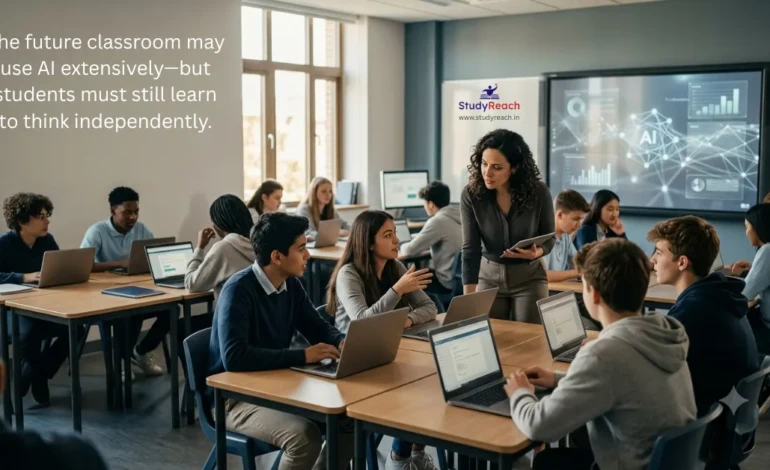
Artificial Intelligence is already changing the way people work, learn and solve problems. Students can use AI to explain a difficult concept, practise a language, generate ideas or receive instant feedback.
But there is a bigger question that schools and parents should be asking:
That is the real education challenge of the AI era.
The World Economic Forum’s Future of Jobs research expects significant changes in job roles and skills through 2030. It identifies analytical thinking as a leading core skill while also highlighting creative thinking, resilience, flexibility, technological literacy and AI-related skills. :contentReference[oaicite:1]{index=1}
UNESCO and the OECD are also moving beyond the idea that students simply need to “learn AI”. They emphasise responsible use, critical judgement, ethics, creativity and the ability to understand how AI systems affect people and society. :contentReference[oaicite:2]{index=2}
So, what should schools actually prepare students for?
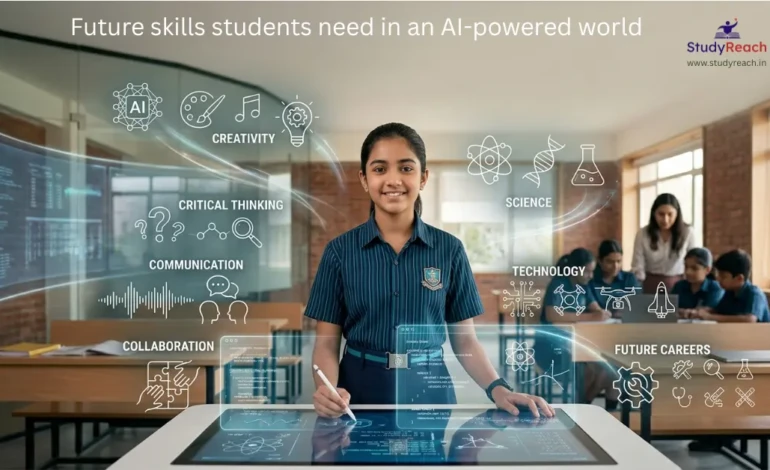
Here are 10 future skills for students that I believe deserve much more attention in today’s classrooms.
1. Critical Thinking
If AI can provide an answer in seconds, students need to become better at asking whether that answer is actually correct.
This is why critical thinking may become even more important in the AI era.
Students should learn to question information, compare sources, identify assumptions and recognise when something does not make sense.
Imagine a student asking an AI tool to explain a history topic. The answer may sound confident and well written. But confidence does not always mean accuracy.
A future-ready student should be able to ask:
- Where did this information come from?
- Can I verify it?
- Is there another point of view?
- What evidence supports this answer?
- Could the AI be wrong?
School takeaway: Give students more activities where they have to defend an answer, compare evidence and explain their reasoning — not simply reproduce information.
2. AI Literacy
Students do not all need to become AI programmers.
But they do need to understand AI.
AI literacy means knowing what AI can do, where it can fail, how its outputs should be checked and when it is appropriate to use it.
UNESCO’s AI Competency Framework for Students identifies competencies around human-centred thinking, AI ethics, AI techniques and AI system design. It also sees students not simply as users, but as responsible and creative participants in an AI-powered world. :contentReference[oaicite:3]{index=3}
Don’t ask only, “Can AI do this for me?”
Also ask, “Should I use AI for this, and how can I use it responsibly?”
For students who want to explore this area practically, StudyReach has already covered AI tools for students in 2026.
3. Creativity
There was a time when people worried that computers would make creativity less important.
AI has made that question even more interesting.
AI can generate images, stories, presentations, music and ideas. So what is left for the student?
A great deal.
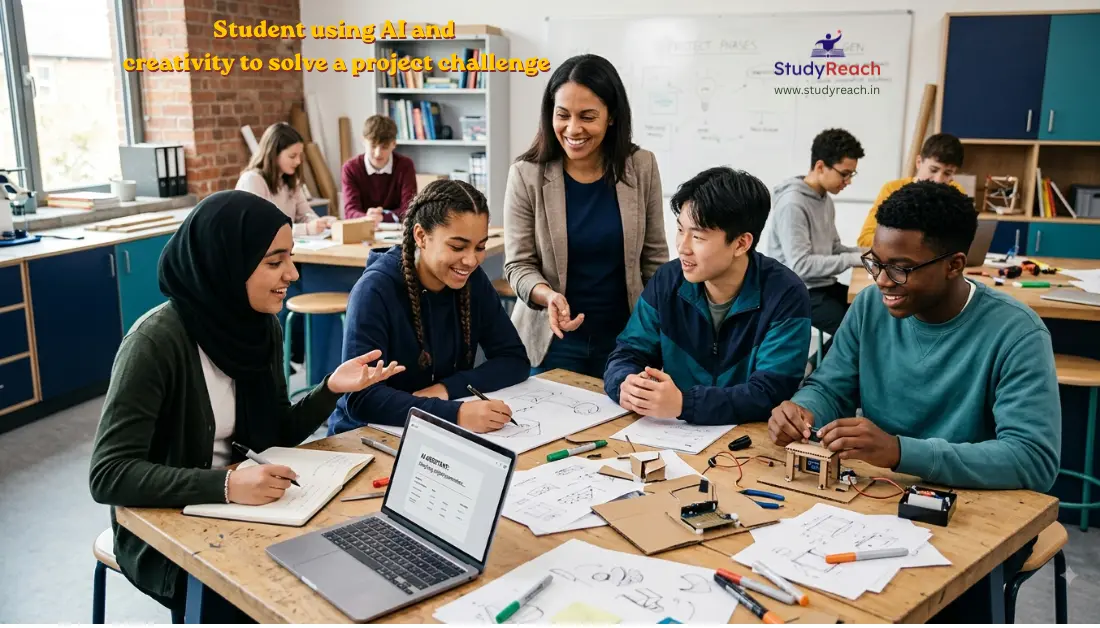
Creativity is not simply producing something new. It is seeing connections that others may not see. It is asking unusual questions. It is imagining possibilities.
A student who can combine human imagination with AI tools may be much more powerful than a student who simply asks AI to do everything.
Schools should therefore give students opportunities to:
- Design and build things
- Write original stories
- Solve open-ended problems
- Create presentations and projects
- Experiment without fear of making mistakes
4. Communication Skills
A student may have excellent knowledge and still struggle to explain an idea.
That problem will not disappear because of AI.
In fact, communication may become more valuable.
Future professionals will need to explain ideas to people, work with AI systems, present projects, write clearly and communicate across cultures.
Students should practise:
🗣️ Speaking
Presenting ideas clearly and confidently.
✍️ Writing
Expressing thoughts in a simple, structured way.
👂 Listening
Understanding what another person is actually saying.
🤝 Collaboration
Communicating effectively while working with others.
And there is one important point here: students should not allow AI to become their voice.
AI can help improve writing, but students still need to develop their own ability to think and communicate.
5. Problem-Solving
Real life rarely gives students a question with four options and only one correct answer.
Problems at work and in life are often messy.
There may be incomplete information. There may be several possible solutions. Sometimes the first solution fails.
That is why students need practice solving problems rather than simply solving textbook questions.
Project-based learning, experiments, case studies, entrepreneurship activities and real-life challenges can help develop this skill.
Instead of asking students, “What is the correct answer?”, occasionally ask:
“What would you do if there were no single correct answer?”
6. Adaptability and Resilience
Perhaps the biggest change students will face is that their first career may not remain the same for their entire working life.
Technology changes. Industries change. Job descriptions change.
A student who learns one skill and stops learning may struggle.
A student who learns how to adapt has a much stronger foundation.
Resilience is also important.
Students need to understand that making mistakes, changing direction and starting again are not signs of failure. They are part of learning.
The World Economic Forum identifies resilience, flexibility and agility among the important human capabilities that will remain valuable as technology changes the workplace. :contentReference[oaicite:4]{index=4}
7. Digital and Cyber Safety
Being able to use technology is no longer enough.
Students also need to understand how to use it safely.
They should know about:
- Passwords and account security
- Online privacy
- Scams and misinformation
- Cyberbullying
- Digital footprints
- Responsible sharing of personal information
- Safe use of AI tools
The digital world gives students enormous opportunities, but it also creates new responsibilities.
A future-ready student should be confident online without becoming careless online.
8. Emotional Intelligence
This is one skill that technology cannot simply replace.
Students need to understand themselves and other people.
They need empathy.
They need self-awareness.
They need to manage frustration, work through disagreement and understand how their behaviour affects others.
Think about a workplace where everyone is technically brilliant but nobody knows how to listen, cooperate or handle disagreement.
It would not be a successful workplace.
That is why emotional intelligence belongs in the conversation about future skills for students.
9. Collaboration and Leadership
The future of work is unlikely to be built around people working completely alone.
Students will work with classmates, teachers, colleagues, international teams and increasingly, AI systems.
They need to know how to contribute to a team — and when necessary, how to lead one.
Leadership does not mean always being the loudest person in the room.
Sometimes leadership means listening carefully, giving someone else an opportunity, taking responsibility or helping a team move forward when things become difficult.
- Group projects
- Student councils
- House activities
- Sports
- Debates
- Community projects
- Entrepreneurship activities
10. Lifelong Learning and Self-Directed Learning
This may be the skill that connects all the others.
Students will not be able to learn everything they need for an entire career while they are in school.
They need to learn how to keep learning.
A self-directed learner knows how to identify a gap, find reliable information, practise a new skill, ask for help and measure progress.
AI can actually make this easier.
A student can ask an AI tutor for an explanation, generate practice questions, receive feedback and explore a topic beyond the textbook.
But the student still needs curiosity and discipline.
Technology can provide opportunities.
The learner still has to make the effort.
The 10 Future Skills at a Glance
| Skill | Why It Matters in an AI-Powered World |
|---|---|
| Critical Thinking | Helps students question, verify and evaluate information. |
| AI Literacy | Helps students understand and use AI responsibly. |
| Creativity | Helps students generate original ideas and solutions. |
| Communication | Helps students explain ideas clearly to people and technology. |
| Problem-Solving | Prepares students to handle complex real-world challenges. |
| Adaptability | Helps students respond to changing careers and technology. |
| Digital Safety | Protects students while they learn and work online. |
| Emotional Intelligence | Strengthens empathy, relationships and self-management. |
| Collaboration & Leadership | Prepares students to work effectively with people and AI. |
| Lifelong Learning | Helps students continue developing after school and college. |
What Should Schools Change?
Reading a list of ten skills is easy.
Building them into school life is harder.
Schools do not necessarily need ten new subjects.
In many cases, these skills can be developed through the way existing subjects are taught.
📚 In English
Debates, presentations, creative writing and argument-based tasks can build communication and critical thinking.
🔬 In Science
Experiments and real-world investigations can develop problem-solving and curiosity.
💻 In Technology
AI literacy, digital safety and responsible technology use can become part of practical learning.
🎨 In Arts
Creative projects can strengthen imagination, originality and confidence.
Even assessment needs to evolve.
If every assessment rewards only memorisation, students will naturally focus on memorisation.
If assessment also rewards reasoning, creativity, communication, collaboration and application, students begin developing those abilities.
What Should Parents Do?
Parents sometimes feel that they need to know every new technology before their children do.
They don’t.
What parents can do is encourage curiosity.
Ask questions such as:
- What did you learn today?
- Why do you think that answer is correct?
- Could there be another solution?
- What would you do differently next time?
- How did you use technology to learn?
Parents should also be careful about allowing AI to do everything for a child.
If AI writes every essay, solves every problem and prepares every presentation, the student may finish the assignment without developing the skill the assignment was designed to teach.
The goal should be AI-assisted learning, not AI-dependent learning.
What About Students Who Are Not Interested in Technology?
This is an important question.
Not every student wants to become a software engineer or AI specialist.
And that is perfectly fine.
The future will need doctors, teachers, designers, lawyers, entrepreneurs, scientists, artists, skilled technicians, healthcare professionals and many other kinds of workers.
AI will affect almost all of these fields in some way, but that does not mean every student needs to become an AI expert.
What every student does need is the ability to learn, adapt and work intelligently with changing technology.
AI Will Change Education — But It Should Not Define Education
This distinction matters.
Schools should not rush to add AI simply because AI is fashionable.
The question should always be:
If the answer is yes, use it.
If the technology simply makes students dependent on shortcuts, rethink the approach.
This is also why the role of the teacher remains important. AI can generate content, but a teacher understands the child sitting in front of them — their confidence, confusion, motivation, behaviour and potential.
StudyReach has explored this broader issue in How AI Is Reshaping Education in India.
For an India-specific perspective, you can also read NEP 2020 and AI in Indian Education.
The Future Student Will Be More Than an AI User
There is a temptation to believe that the students who know the most AI tools will automatically have the greatest advantage.
I don’t think it is that simple.
The student who knows ten AI tools but cannot judge whether their output is reliable may struggle.
The student who can write excellent prompts but cannot communicate an original idea may struggle.
The student who can automate everything but cannot work with people may struggle.
The real advantage will come from combining technology skills with human capabilities.
🚀 The Future-Ready Student
Knows how to use AI.
Knows when not to use AI.
Can think independently.
Can communicate clearly.
Can create something original.
Can work with others.
And most importantly — keeps learning.
Final Thoughts
The future of education should not be about preparing students for one particular job.
It should be about preparing them for a world where jobs, tools and expectations will continue to change.
That is why the conversation around future skills for students is so important.
Students do not need to be afraid of AI.
They also should not blindly depend on it.
They need to understand it, question it, use it responsibly and — when necessary — put it aside and think for themselves.
As educators, parents and school leaders, perhaps our greatest responsibility is not to predict exactly what the future will look like.
It is to give students the confidence and skills to face whatever that future brings.
One Question for Parents, Teachers & Students
If AI can give students information instantly,
what should schools spend more time teaching?
That conversation is worth having.
Share your thoughts with StudyReach.
Frequently Asked Questions
What are the most important future skills for students?
Important future skills include critical thinking, AI literacy, creativity, communication, problem-solving, adaptability, digital safety, emotional intelligence, collaboration and lifelong learning.
Do students need to learn AI to succeed in the future?
Students do not all need to become AI specialists or programmers. However, basic AI literacy is increasingly important so that students can understand AI, evaluate its outputs and use it responsibly.
Will AI make traditional education skills less important?
Not necessarily. Reading, writing, mathematics, communication and critical thinking remain important. AI changes how these skills may be applied, but strong foundational skills help students use technology effectively.
How can schools prepare students for an AI-powered future?
Schools can integrate AI literacy, project-based learning, problem-solving, communication, creativity, collaboration and digital safety into existing subjects rather than treating future skills as completely separate subjects.
How can parents prepare children for future careers?
Parents can encourage curiosity, independent thinking, communication, responsible technology use, problem-solving and lifelong learning rather than focusing only on marks or a single career path.
About the Author

Shailendra Porwal
Shailendra Porwal is an experienced school educator, Principal and education professional with extensive experience in school leadership, teaching-learning practices, academic planning and educational administration.
As the Founder and Author of StudyReach.in, he shares practical and easy-to-understand insights for students, parents, teachers and education leaders.
His approach is simple: make education practical, meaningful and relevant to the changing needs of learners.