CBSE Cluster & Zone Tournament 2026-27

CBSE Cluster & Zone Tournament 2026-27:
Complete Guide — Purpose, Structure, Calendar & Rules
Everything a school principal, PTE, teacher, student, and parent needs to know about CBSE’s annual sports tournament system — from cluster to national level.
📋 Table of Contents
- What Are CBSE Cluster & Zone Tournaments?
- History & Background
- Official Aims & Objectives
- Three-Level Tournament Structure
- Organizing Committee — Who Does What
- All Clusters in India — Full List
- 24 Games — Complete Sports List 2026-27
- 2026-27 Sports Calendar
- How to Register — 3-Step Process
- Key Rules Every School Must Know
- FAQ
Every year, across thousands of CBSE-affiliated schools in India, students lace up their shoes, pick up their rackets, and step onto fields and courts — not just to play, but to represent their school at one of the most structured inter-school sports systems in the country.
The CBSE Cluster and Zone Tournament is India’s largest school-level multi-sport competition system. Yet surprisingly, many parents, students, and even some teachers don’t fully understand how it works — how teams qualify, who organises the events, what the prize system is, and how a student can eventually play at the national level.
This guide covers everything — from the first circular CBSE sends to schools, to the moment a student stands on a national podium with a medal.
1. What Are CBSE Cluster & Zone Tournaments?
CBSE organizes sports events at Cluster/Zonal and National levels for students of its affiliated schools every year in various age-groups for girls and boys separately. These are not one-off events — they are an annual, structured, progressive tournament system where students compete at progressively higher levels.
Think of it as a pyramid: thousands of schools participate at the Cluster level, the best teams move to the Zonal level, and the best from each zone compete at the National level. The process repeats every academic year across 24 different sports.
2. History & Background
CBSE has been organizing interschool sports competitions since the early decades of its establishment. The formal multi-level Cluster-Zone-National structure evolved over the years as CBSE’s affiliated school network expanded from a few hundred schools to over 26,000 schools across India and abroad.
The introduction of the Cluster system was a practical solution to geography — India is too large for every school to directly compete at the national level. By dividing the country into regional clusters, CBSE ensured that every school, whether in a metro or a small town, has a fair entry point into competitive sports.
Over the decades, the system has grown to include 20 Clusters and multiple Zones, covering all states and Union Territories. The introduction of the online CBSE Sports Portal in recent years brought registration, results, certificates, and reporting onto a single digital platform — making the system more transparent and accessible.
COSCO India Ltd has been the official sponsor of CBSE Inter School Sports & Games for many years, supplying playing equipment for competitions at all levels.
3. Official Aims & Objectives
The Chairman, CBSE shall be the Chairman of the Sports Committee. The official aims are clearly stated in CBSE’s organisational rules:
Interschool Tournaments
To organize competitions in games and sports officially recognized by CBSE across all affiliated schools.
Sportsmanship & Friendship
To encourage sportsmanship and promote friendly relations among schools across regions.
Raise Sports Standards
To raise the general standard of sports and games in CBSE schools across India.
All-Round Development
To work for all-round development and values through sports amongst students.
Teacher Training
To organize orientation, refresher and training programs for Physical Education Teachers.
Khelo India Pathway
Gold medalists in specific individual games qualify for Khelo India Games and SGFI National School Games.
4. Three-Level Tournament Structure
Every CBSE sport follows the same progressive structure. A student must win at each level to advance to the next:
5. Organizing Committee — Who Does What
The Principal of the Host School shall nominate a competent body to be known as the “Organizing Committee.” This committee shall function under his supervision and it will be the responsibility of the Principal for organizing the tournament, according to the CBSE Rules.
Overall Authority & Accountability
The host school principal holds full responsibility for the tournament. Any rule infringement is ultimately the principal’s responsibility. They nominate the entire organizing committee.
Day-to-Day Tournament Management
The Principal will designate a competent member of the staff as the “Organizing Secretary.” This person manages fixtures, communication, scheduling, and results documentation.
PETs, Experts & Teachers
The Organizing Committee may also include Principal/PET/Experts/Teachers from other schools. It is a collaborative structure — not limited to just the host school’s staff.
Dr. Manjit Singh — Head (Sports), CBSE
The national point of contact for all CBSE sports queries is Dr. Manjit Singh, Additional Director (Sports), CBSE. Email: manjit.cbse@gmail.com
Gender Gap in Learning 2026 | Source: StudyReach.in
6. All Clusters in India — Complete List
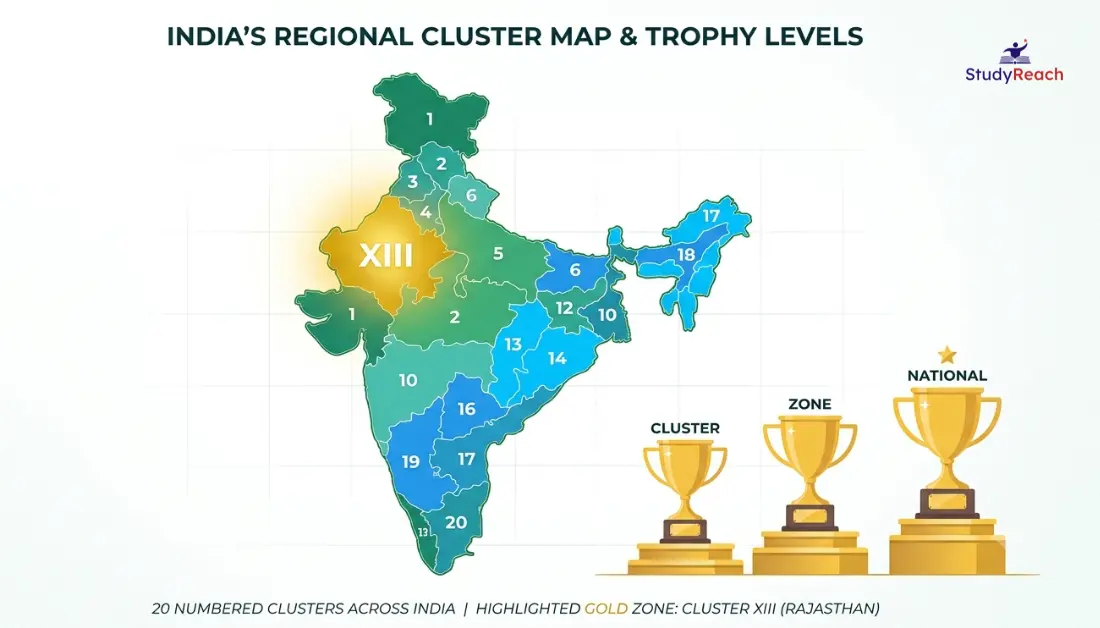
India is divided into 20 Clusters, each managed under a CBSE Regional Office. Every CBSE school belongs to one cluster based on its state/UT:
| Cluster | States / UTs Covered | CBSE Regional Office |
|---|---|---|
| I | Assam, Manipur, Arunachal Pradesh, Meghalaya, Sikkim, Nagaland, Mizoram, Tripura | Guwahati |
| II | Odisha, West Bengal, Chhattisgarh | Bhubaneswar / Raipur |
| III | Bihar, Jharkhand | Patna |
| IV | Uttar Pradesh (East) | Varanasi / Prayagraj Region |
| V | Uttar Pradesh (West) | Noida / Meerut Region |
| VI | Tamil Nadu, Puducherry, Andaman & Nicobar | Chennai |
| VII | Andhra Pradesh, Telangana | Vijayawada / Hyderabad |
| VIII | Kerala, Lakshadweep | Thiruvananthapuram |
| IX | Karnataka | Bengaluru |
| X | Maharashtra (Pune Region) | Pune |
| XI | Maharashtra (Mumbai Region), Goa, Dadra & Nagar Haveli, Daman & Diu | Mumbai |
| XII | Madhya Pradesh | Bhopal |
| XIII | ⭐ Rajasthan | Jaipur / Ajmer |
| XIV | Gujarat | Ahmedabad |
| XV | Punjab, Chandigarh | Chandigarh |
| XVI | Haryana | Panchkula |
| XVII | Himachal Pradesh, J&K, Ladakh | Dehradun Region |
| XVIII | Uttarakhand | Dehradun |
| XIX | Uttarakhand + UP (certain regions) | Dehradun / Noida |
| XX | Delhi (East + West) | Delhi East / Delhi West |
7. 24 Games — Complete Sports List 2026-27
CBSE sports competition 2026-27 will be held for 24 games under various categories at cluster, zonal, and national levels.
8. CBSE Sports Calendar 2026-27 — At a Glance
| Activity | Dates 2026-27 | Status |
|---|---|---|
| Online Proposals by Schools to Organise Games | March–April 2026 | ✅ Completed |
| Online Registration of Students (UID Creation) | April–May 2026 | ✅ Completed |
| Apply to Participate (Step 2 — Mandatory) | May 2026 | ✅ Completed |
| Cluster Level Games | June 1 – July 14, 2026 | 🔴 ONGOING NOW |
| Zonal Level Games | July – August 2026 | 🔴 ONGOING |
| National Level Games | September 20 – October 20, 2026 | 🟢 Upcoming |
| Certificates & Results Upload | After each level event | 🟢 Rolling |
9. How to Register — 3-Step Online Process
All registrations are online only. No offline submission is accepted by CBSE. Schools must complete all three steps — missing any step disqualifies the student.
Register Students — Create UID
Go to cbse.gov.in → CBSE Sports System → Registration/Apply to Participate. Register each student to generate a unique UID. This UID remains valid for their entire tenure in CBSE schools — it is created once and used every year.
Apply to Participate — Select the Game
After registration, specifically enrol each student into their chosen game by clicking “Apply to Participate.” Skipping this step disqualifies the student/team even if UID was created. Both steps are mandatory.
Email Confirmation to Organizing School
After completing Steps 1 and 2, send an email to the organizing school confirming participation at least one week before the event. This allows the host to plan logistics, accommodation, and fixtures accurately.
10. Key Rules Every School Must Know
- No team without manager: No team will be allowed to participate without a Team Manager/Coach/Physical Education Teacher designated by the participating school principal.
- Videography compulsory: All sports events at Cluster, Zonal, and National levels must be videographed. Records maintained for 3 months.
- Suspension rule: If a tournament is suspended indefinitely, CBSE decides the new venue and dates. If no host is available, the Cluster/Zone is merged with a nearby one.
- Equipment: Shuttle-cocks, tennis-balls, footballs, volleyballs, basketballs are arranged by the organizing school from the CBSE sports grant. No extra payment by CBSE.
- Railway concession: Qualified teams receive a letter to help procure Railway Concession for travel to the next level of competition.
- Medals & Certificates: All participants get Participation Certificates. Winners get Merit Certificates & Medals. Certificates are available online in PDF format via the CBSE Sports Portal.
- Results reporting: Results must be uploaded up to 4th place in team events and 6th place in individual events.
📎 CBSE Sports System (registration & portal): cbseit.in — CBSE Sports System
📎 Download 2026-27 Sports Calendar PDF: CBSE Sports Calendar 2026-27 (Latest)
📎 SAI infrastructure specifications: saijobs.sportsauthorityofindia.gov.in
FAQ — Most Common Questions
🏆 The Bottom Line
The CBSE Cluster and Zone Tournament system is one of the most structured school sports pathways in India. It gives every student — from a small-town school to a metro institution — a fair shot at competing at the highest level. If your school is not yet participating, this is the year to start. The process is fully online, well-supported, and the rewards — for students, schools, and communities — are real.