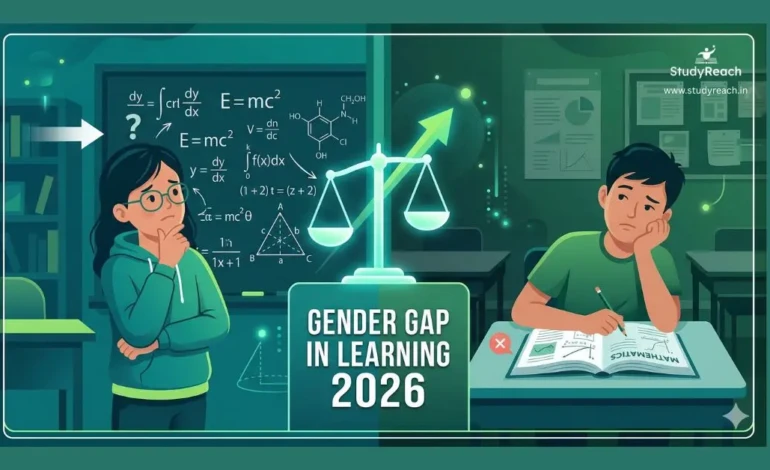
Gender Gap in Learning 2026:Boys vs. Girls in STEM & Literacy

Boys accelerate in math. Girls lead in reading. But both genders are missing opportunities in 2026. 📚⚗️
Here’s what the latest research says — and what parents, teachers & students must do now.
📋 Table of Contents
- Understanding the Gender Gap in Learning
- USA 2026 — What the Data Really Shows
- The STEM Gap: Why Girls Step Back
- The Literacy Gap: Why Boys Fall Behind in Reading
- Boys vs Girls — Complete Data Comparison Table
- Real-Life Examples from Schools
- The India Angle — Where Do We Stand?
- What Parents & Teachers Can Do Right Now
- FAQs
- Final Words
🎓 Understanding the Gender Gap in Learning
The gender gap in learning is one of the most debated education topics of 2026. For decades, conversations around this issue focused on getting girls into schools. Today, the challenge is far more nuanced — girls are in school, they’re graduating, they’re even outperforming boys in several areas. But the gaps in STEM participation, math confidence, and male literacy are widening in ways that should concern every parent and teacher.
This is not a story about one gender suffering while the other thrives. It’s a story about both boys and girls facing missed opportunities at different points in their educational journey — and about how our classrooms, curricula, and parenting styles may be reinforcing invisible barriers we don’t even realize exist.
In 2026, experts confirm that boys and girls follow different but equally important academic trajectories. Boys tend to accelerate in math while girls maintain a steady lead in reading — and those early differences shape confidence and career paths well into adolescence and beyond.
🇺🇸 USA 2026 — What the Data Really Shows
The United States serves as the clearest mirror for this global crisis. The data from 2026 is striking — and paints a picture of two parallel crises happening at the same time.
Despite persistent STEM gaps, women now earn the majority of bachelor’s, master’s, and even doctoral degrees in the USA overall. The crisis is not about access to education — it’s about which subjects each gender gravitates toward, and the invisible forces that pull them in different directions.
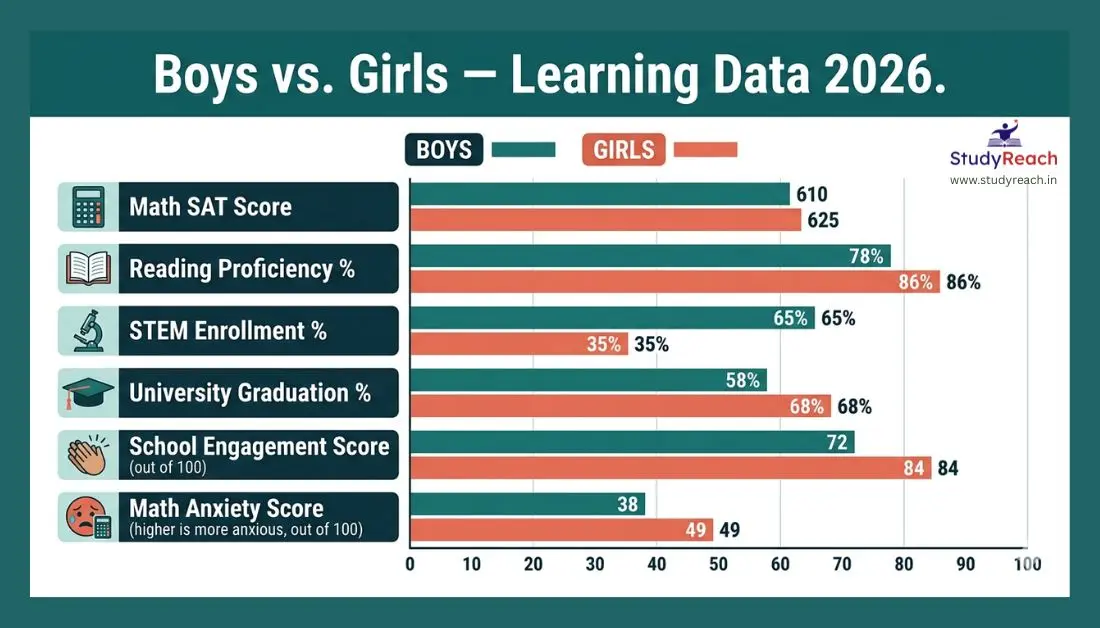
Gender Gap in Learning 2026 | Source: StudyReach.in
⚗️ The STEM Gap: Why Girls Step Back
Girls perform equally well as boys in most K–12 STEM subjects. Yet, something shifts — particularly in middle school — that causes many girls to disengage from science and technology. Research identifies this as the “confidence cliff” in STEM.
By middle school, more than twice as many boys than girls intend to pursue science or engineering careers. Girls’ participation in computer science, which is not compulsory in all states, drops from 44% in middle school to just 33% in high school. This is not because of ability — it’s because of perception, stereotype, and subtle social messaging.
Research published in the Journal of Experimental Social Psychology confirms that when girls are reminded of gender stereotypes before a math test, their scores drop — even when their actual ability is identical to boys. This “stereotype threat” is a powerful, invisible force shaping girls’ relationship with STEM from elementary school onward.
The AAUW (American Association of University Women) points out that girls are less likely to be steered toward physics, calculus, and computer science — the very gateway courses to high-paying STEM careers. Despite making up 51% of the US population, women make up only 38.8% of STEM bachelor’s degree recipients and just 26% of the STEM workforce.
📖 The Literacy Gap: Why Boys Fall Behind in Reading
While the STEM story is about girls being underrepresented, the literacy story flips the narrative entirely. Boys are consistently falling behind girls in reading and verbal skills — a crisis that has been building for over a decade and is now reaching an alarming peak in middle school.
Only 30% of 8th-grade boys in the USA are reading at grade level, with no state showing improvement since 2022. Students who were in K–3 during the COVID-19 pandemic are now in middle school — and many still haven’t recovered their foundational literacy skills.
- Boys develop verbal skills slightly later than girls on average
- Reading is often perceived as a “girl subject” — reducing boys’ motivation
- Lack of engaging, age-appropriate reading material for boys (action, adventure, non-fiction)
- Boys report more negative attitudes toward school and invest less time in homework
- Female-dominated primary school teaching reduces male role models for reading
Cross-country PISA studies across 64 countries confirm a remarkably consistent pattern: boys are less likely than girls to achieve basic proficiency in core subjects, report investing less effort on schoolwork, and are more likely to drop out of tertiary education. Meanwhile, girls report higher anxiety about math — a confidence gap, not an ability gap.
📊 Boys vs. Girls — Complete Learning Data Comparison (2026)
🏫 Real-Life Examples from Schools
This initiative specifically targets the confidence drop girls experience in middle school. After participation, 80% of alumni pursue computer science in college compared to 22% of the general female student population — proving the gap is about environment, not ability.
Florida introduced BookAdventure — a program using graphic novels, adventure books, and sports biographies specifically chosen to engage reluctant boy readers. Schools saw a 34% improvement in male reading participation within one academic year.
In 2026, IIT Madras launched 6 free AI courses in Hindi — a step toward making STEM more accessible to women in non-English-medium backgrounds. The initiative directly targets the language + gender double barrier faced by millions of Indian girls.
UNESCO’s annual Scientific Camps of Excellence for Girls in Kenya connect female students with women scientists as mentors. The UN identified this as a global best practice — with girls showing significantly higher STEM aspiration post-camp.
In a Class 10 CBSE school in Rajasthan, Priya topped her class in Science but was gently guided toward Commerce by her family — “Science is for boys.” Meanwhile, Rahul, who loved stories and Hindi literature, was pushed into Science stream because “boys should do Science.” Both chose wrong subjects based on gender expectations, not actual passion or ability. Their story is not unique — it’s playing out in millions of Indian homes every year.
🇮🇳 The India Angle — Where Do We Stand?
India presents a layered and complex picture. On one hand, the country has achieved near-universal primary enrollment with girls now making up 48% of the total school population. On the other hand, the quality, subject-choice, and retention disparities remain deeply concerning.
India has made extraordinary progress — from 0.41 girls per boy in primary school in 1950 to 1.02 girls per boy today. However, deep-rooted socio-cultural factors continue to limit girls’ choices in STEM, and the literacy gap of 17.2 percentage points between men and women remains one of the largest in Asia. Early marriage, family pressure, and lower educational spending on girls in states like Bihar and Uttar Pradesh compound the challenge.
💡 What Parents & Teachers Can Do Right Now
👧 To Support Girls in STEM
- Never say “Math is hard for girls” — even casually
- Introduce female scientists & engineers as role models
- Enrol girls in coding clubs, robotics, and science fairs
- Encourage a growth mindset: ability is built, not born
- Praise effort over innate talent in STEM subjects
- Use schemes like CBSE’s Vigyan Tarang or YUVA AI
👦 To Support Boys in Literacy
- Choose books that genuinely interest them — sports, adventure, mystery
- Never mock a boy for reading — normalize it actively
- Read together as a family — model male reading behavior
- Use graphic novels and non-fiction as entry points
- Allow audio books and e-books — format doesn’t matter
- Limit screen time; create a 20-minute daily reading habit
👩🏫 For Teachers (Classroom Tips)
- Avoid unconscious gender-based task assignments
- Call on boys AND girls equally in science & math
- Use gender-neutral language in problem statements
- Celebrate girls’ STEM achievements publicly in class
- Introduce male-authored reading material alongside female voices
🏫 For Schools (Policy Level)
- Offer gender-neutral career counselling from Class 8
- Make CS/coding compulsory for all — not just boys
- Run dedicated girl-STEM and boy-literacy programs
- Invest in female STEM teachers as visible role models
- Track subject-choice data by gender and intervene early
🔗 Trusted Research Resources
📖 Related Articles on StudyReach.in
❓ Frequently Asked Questions (FAQ)
Q1. Is the gender gap in learning getting better or worse in 2026? ▼
It’s a mixed picture. The math gap between boys and girls is narrowing — from a 22-point SAT gap in 2017 to 15 points in 2026. But the male literacy crisis is widening, with only 30% of 8th-grade boys reading proficiently and no state showing improvement. The STEM workforce gender gap remains largely unchanged at about 72% male, 28% female.
Q2. Are boys naturally better at math and girls better at reading? ▼
No — research consistently shows that actual ability differences are negligible in K–12 math. Girls earn higher grades in math than boys in most cases. The gaps observed are primarily driven by social influences, stereotypes, and confidence — not innate ability. The reading gap is partly developmental (boys develop verbal skills slightly later) but is greatly amplified by cultural messaging that reading is “for girls.”
Q3. What is “stereotype threat” and how does it affect girls in STEM? ▼
Stereotype threat is when awareness of a negative stereotype about your group affects your actual performance. When girls are reminded — even subtly — that “boys are better at math,” their test scores drop measurably even if their actual ability is identical. This effect is strongest in middle school when gender identity becomes more prominent, and it contributes significantly to girls avoiding advanced STEM courses.
Q4. How does the gender gap in education affect India specifically? ▼
India has made remarkable progress in enrollment — girls now make up 48% of the school population. However, women make up only 42.5% of STEM students from undergraduate to PhD level, the adult female literacy rate (64.63%) trails male literacy (80.88%) by over 17 percentage points, and households in states like Bihar spend up to twice as much on boys’ education as girls’. Social pressures, early marriage, and subject-based stereotypes remain the biggest barriers.
Q5. What can parents do to encourage their daughter toward STEM? ▼
Start early and stay consistent. Expose girls to female scientists and engineers as role models. Use science kits, coding apps, and math games at home. Avoid gendered praise like “you’re naturally good at arts.” Enroll daughters in coding clubs or robotics if available. Most importantly, never make subject choices based on gender — help your daughter choose based on her genuine interest and strengths, not social expectation.
Q6. What government schemes in India help bridge the gender gap in education? ▼
Several schemes target girls’ education: Beti Bachao Beti Padhao (nationwide awareness and enrollment drive), Kasturba Gandhi Balika Vidyalaya (residential schools for girls from marginalized groups), CBSE Udaan Scheme (to support girls in STEM for IIT/NIT entrance), and the YUVA AI for All initiative (free AI literacy for all students). The NEP 2020 also explicitly targets gender equity in education access and subject choice.
📝 Final Words — From the StudyReach Desk
The gender gap in learning is not about which gender is smarter or more capable. It never was. It is about the invisible scripts we hand to children from the moment they are born — “girls do arts,” “boys do science,” “math is not for you,” “reading is not for him.”
In 2026, the data is clear: both boys and girls are paying a price for these stereotypes. Girls are losing confidence in STEM before they even try. Boys are falling dangerously behind in literacy — a skill that underpins every other area of life.
As parents and teachers in India, we have a profound opportunity — and responsibility — to rewrite these scripts for the next generation. Give every child the freedom to learn what they love, and the encouragement to believe they can master whatever they choose. That’s not just good parenting. That’s nation-building. 🙏

Shailendra Porwal is an educator, career counsellor, and the founder of StudyReach.in — a trusted platform for students, parents, and teachers across India. With years of experience in academic guidance, CBSE curriculum, and study-abroad consulting, Shailendra is passionate about making quality education content accessible to every learner. His writing blends research, real-world experience, and genuine care for student success.
🌐 Visit StudyReach.in