CBSE vs ICSE

CBSE vs ICSE 2026: Which Board is Best for Your Child?
An honest, complete comparison — syllabus, fees, difficulty level, JEE/NEET readiness, and who should choose which board.
The debate around CBSE vs ICSE is one of the most searched education questions in India — and for good reason. Both boards are nationally respected, but they prepare children for very different futures. Before you fill that school admission form in 2026, read this complete guide to understand exactly which board matches your child’s learning style and career goals.
📋 Table of Contents
1. What is CBSE and ICSE?
India has several education boards, but CBSE and ICSE are the two most popular national-level boards among private and English-medium schools. Here is a plain-language overview of each:
🏛️
CBSE — Central Board of Secondary Education
Governing Body: Government of India
Curriculum: NCERT — National Council of Educational Research and Training
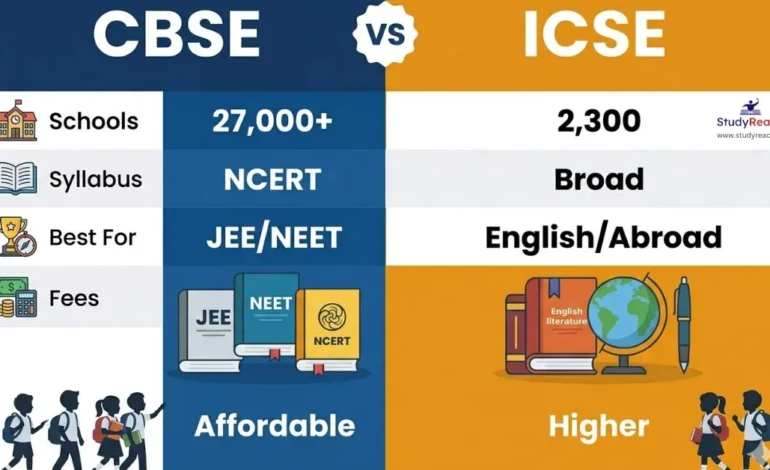
Affiliated Schools: 27,000+ across India
Best For: JEE, NEET, UPSC and all national competitive exams
📖
ICSE — Indian Certificate of Secondary Education
Governing Body: CISCE — Council for the Indian School Certificate Examinations (Private)
Affiliated Schools: ~2,300 (mostly urban, private)
Best For: English proficiency, analytical learning, and study abroad pathways
2. CBSE vs ICSE — Complete Comparison Table (2026)
This at-a-glance table covers the 12 most important comparison points that Indian parents search for before making a school board decision.
3. Syllabus and Curriculum Depth
CBSE follows the NCERT curriculum, which is standardised and consistent across all affiliated schools in India. The syllabus is designed to build a strong foundation in Science and Mathematics — subjects that directly align with entrance exams like JEE and NEET. It avoids unnecessary depth in secondary subjects, keeping the learning load manageable.
ICSE, governed by the Council for the Indian School Certificate Examinations (CISCE), follows a broader and more detailed curriculum. Students study 7 to 8 compulsory subjects including English Language, English Literature, Environmental Science, and Computer Studies — even in middle school. Schools have the freedom to choose textbooks from multiple publishers, giving teachers more flexibility in delivery.
4. Difficulty Level and Scoring Pattern
A very common parent question is: “Is ICSE harder than CBSE?” The honest answer is that both boards test different skills, so direct comparison can be misleading. What is true is that ICSE expects more detailed, descriptive answers and covers a wider range of subjects — which many students find more intensive in terms of study hours.
✅ CBSE — Scoring Strengths
- Step-wise marking — partial marks awarded
- More predictable question patterns
- NCERT-aligned, less surprise in questions
- Easier to consistently score 85–95%
- MCQ sections reduce subjective risk
📌 ICSE — Scoring Reality
- Detailed essay-style answers expected
- Internal assessments + practicals add pressure
- Scoring 90%+ is genuinely challenging
- Rewards strong writing and analytical skills
- Builds deeper understanding over time
5. JEE, NEET and Competitive Exam Readiness
This is the section most engineering and medical aspirant families need to read carefully. CBSE has a clear and proven advantage for JEE and NEET preparation. Both exams are set by national bodies that directly base their questions on NCERT Class 11 and Class 12 content — the exact textbooks CBSE students use every day. A CBSE student essentially covers board exam and entrance exam preparation simultaneously.
ICSE students are not unable to crack these exams — thousands do every year. However, they typically need dedicated NCERT coaching on the side to fill the curriculum gap, which adds to time and cost. Many ICSE students make a practical switch to CBSE at Class 11 specifically to optimise for JEE or NEET.
🏆 Competitive Exam Verdict
JEE / NEET / UPSC / CUET → Choose CBSE | Study Abroad / Humanities / Law → Choose ICSE
6. School Fees and Book Costs
For budget-conscious Indian families, this difference is significant. CBSE includes government-aided schools like Kendriya Vidyalayas (KV) and Jawahar Navodaya Vidyalayas (JNV), which offer world-class education at very low fees. Even private CBSE schools tend to be more affordable than ICSE institutions, which are predominantly private and urban.
On books: NCERT textbooks, used by all CBSE schools, are government-published and available at ₹300 to ₹1,200 per year for all subjects. ICSE schools prescribe books from multiple private publishers, which typically cost ₹1,500 to ₹3,500 or more per year — nearly three times the CBSE cost.
7. College Admissions and Recognition in India and Abroad
Both boards are fully recognised and equally accepted by every university in India — including IITs, NITs, AIIMS, Delhi University, Mumbai University, and all state universities. You will not be rejected from any Indian college based on whether you studied under CBSE or ICSE.
For international universities, ICSE has a slight but real advantage. Its curriculum design is closer to the British IGCSE system, making it more familiar to foreign university admissions committees. However, for most study abroad applications, what actually determines admission is your academic performance, SAT/ACT/IELTS scores, personal statement, and extracurriculars — not your Indian school board.
8. Who Should Choose CBSE and Who Should Choose ICSE?
Use this quick decision guide to match your situation to the right board:
✅ Choose CBSE If Your Child…
- Aims for JEE, NEET, UPSC or CUET
- Learns better with structured, focused content
- Your family may move cities or states
- You want affordable NCERT textbooks
- You are exploring a KV or JNV school
- Prefers Hindi medium as an option
✅ Choose ICSE If Your Child…
- Loves reading, writing, and analysis
- May pursue humanities, law, or communications
- Has future study abroad plans
- Thrives in a broader, exploratory environment
- A strong ICSE school is available locally
- Needs deeper English language foundation
🎯 StudyReach Final Verdict
There is no universally superior board. CBSE wins on affordability, exam alignment, and portability. ICSE wins on English depth, analytical development, and international compatibility. The school you choose matters far more than the board label — a great CBSE school will outperform a poorly run ICSE school every time. Focus on teacher quality, school culture, and your child’s individual learning personality.
📚 Also Read on StudyReach.in
9. Frequently Asked Questions — CBSE vs ICSE
Q1. Which is better — CBSE or ICSE in 2026?
There is no single correct answer. CBSE is better for students targeting JEE, NEET, or UPSC. ICSE is better for students who want strong English skills, broader academics, or plan to study abroad. The school quality ultimately matters more than the board name.
Q2. Is ICSE harder than CBSE?
ICSE covers more subjects in greater detail, especially English and Social Studies. Many students find the study volume more intensive. CBSE is more streamlined, making it easier to score high marks with a focused study plan.
Q3. Which board is better for JEE and NEET preparation?
CBSE is clearly better. JEE and NEET question papers are built on NCERT content — the same textbooks that CBSE students study for board exams. ICSE students need additional NCERT revision alongside their regular schoolwork.
Q4. Can a student switch from ICSE to CBSE?
Yes. Switching from ICSE to CBSE after Class 10 is very common among students planning JEE or NEET. Most CBSE schools accept ICSE students for Class 11 admission. The transition is smooth since ICSE covers a broader base.
Q5. Which board is more affordable for Indian families?
CBSE is significantly more affordable. NCERT books cost ₹300–₹1,200 per year. ICSE private-publisher books cost ₹1,500–₹3,500 or more. CBSE also includes government-aided schools like Kendriya Vidyalayas with very low fees.

Shailendra Porwal founder www.StudyReach.in is an experienced education professional and content strategist. With years of work in school leadership and student guidance, he writes to simplify educational updates for students, parents, and teachers. Studyreach.in brings you timely information about CBSE circulars, scholarship programs, and career guidance to help students excel academically. Stay updated.
Drop or Repeater
Recent Posts
 CBSE vs ICSE
- Drop or Repeater
- Allen Kota
- RBSE 10th Result 2026 OUT: Direct Link & Toppers List
- CBSE Foundational Learning Study 2026 – FLS
- Gender Gap in Learning 2026:Boys vs. Girls in STEM & Literacy
- Cell Phone Ban in Schools ! What Do You Think
- CBSE Class X Second Board Examination 2026 – LOC Guide
- Run Club Benefits for Students: What Science Says
- Freelancing for Students — Complete Beginner Guide