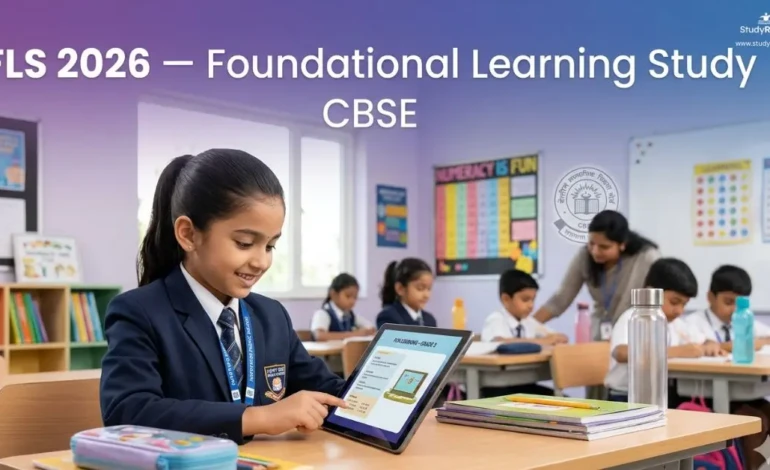
CBSE Foundational Learning Study 2026 – FLS

Everything Schools Need to Know – fls – 2026
A complete guide to CBSE’s FLS 2026 circular — scope, process, digital shift, school responsibilities, and what it means for Grade 3 students across India.
📋 Table of Contents
- What is Foundational Learning Study (FLS) 2026?
- Key Highlights of CBSE Circular Acad-11/2026
- Big Change: From Paper to Digital (Tablet-Based)
- Scale & Scope of FLS 2026
- What Schools Must Do — Responsibilities
- FLS 2022 vs FLS 2026: Comparison Table
- Real-Life Example: How a School Prepares for FLS
- Who Is Involved? Key Stakeholders
- Why FLS 2026 Matters for Indian Education
- Frequently Asked Questions (FAQ)
- Related Articles
What is Foundational Learning Study (FLS) 2026?
The Foundational Learning Study (FLS) 2026 is a large-scale national assessment conducted by PARAKH (Performance Assessment, Review and Analysis of Knowledge for Holistic Development) under NCERT. It is designed to evaluate the Foundational Literacy and Numeracy (FLN) competencies of students at the end of Grade 3.
CBSE issued official Circular No. Acad-11/2026 dated 11 March 2026, directing all CBSE-affiliated school heads to cooperate fully with assessment teams and keep their schools open and functional on scheduled assessment dates in late March 2026.
Key Highlights of CBSE Circular Acad-11/2026
- Circular No: Acad-11/2026, dated 11 March 2026
- Issued by: Dr. Praggya M. Singh, Professor & Director (Academics), CBSE
- Study conducted by: PARAKH at NCERT
- Assessment period: End of March 2026
- Target group: Students completing Grade 3
- Coverage: 10,000+ schools, 1,00,000+ students, 776 districts, 36 States/UTs
- Mode: Tablet-based digital platform (shift from OMR-based paper mode)
Big Change: From Paper to Digital (Tablet-Based)
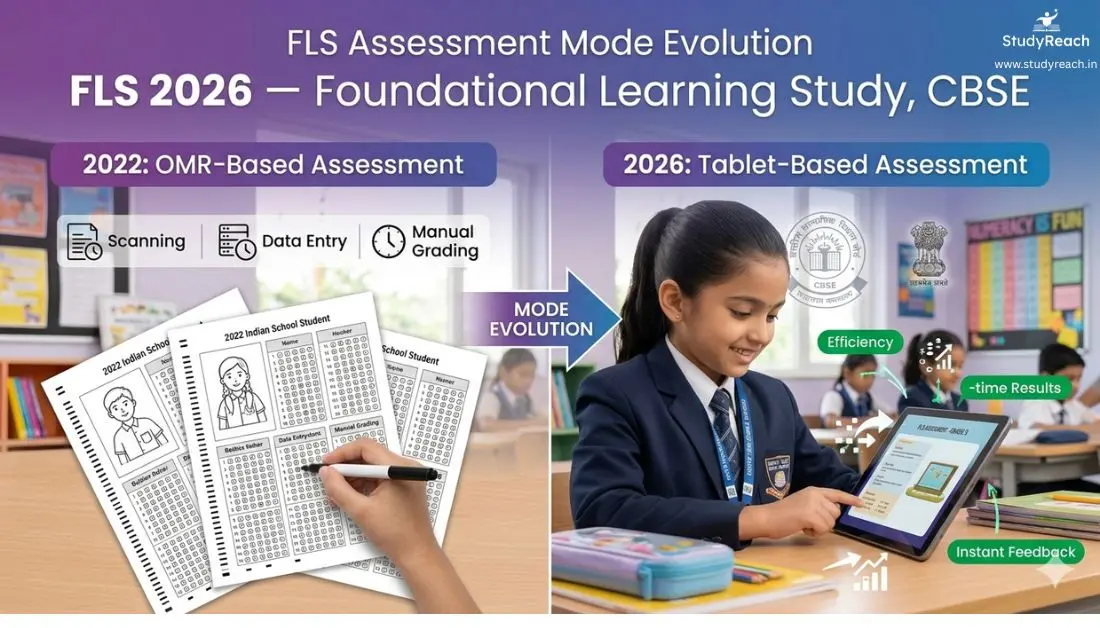
One of the most significant aspects of FLS 2026 is the transition from the earlier OMR-based paper-pen format (used in 2022) to a fully tablet-based digital assessment platform. This shift is expected to:
📊 Better Data Quality
Digital inputs reduce human error in data collection and processing, ensuring more reliable results.
⚡ Faster Reporting
Digital platforms enable quicker compilation and analysis of results compared to manual OMR scanning.
🎯 Targeted Interventions
Real-time data helps policymakers design state-specific FLN improvement programmes more effectively.
Scale & Scope of FLS 2026
FLS 2026 is one of the largest foundational learning assessments in India’s history. Here’s the scale at a glance:
| Parameter | Details |
|---|---|
| Total Schools Covered | More than 10,000 |
| Total Students Assessed | More than 1,00,000 |
| Districts Covered | 776 districts |
| States/UTs | All 36 States and Union Territories |
| School Types | Government (Central & State), Government-aided, Private |
| Target Grade | Grade 3 (End-of-year assessment) |
| Unit of Assessment | State/UT level |
| Assessment Mode | Tablet-based digital platform |
CBSE FLS 2026| Source: StudyReach.in
What Schools Must Do — Responsibilities
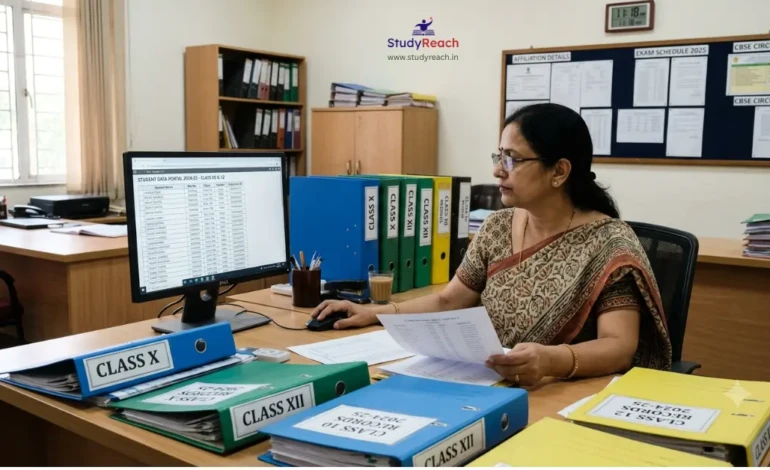
As per the CBSE circular, all heads of CBSE-affiliated schools are required to fulfil the following responsibilities:
- Keep the school open and fully functional on all scheduled FLS assessment dates in late March 2026.
- Extend full cooperation to the assessment teams deputed by PARAKH/State authorities for conducting the study.
- Ensure that Grade 3 students identified in the sample are present and ready for assessment.
- Coordinate with state-level bodies including Samagra Shiksha, SCERTs, SIEs, DIETs, and District Education Offices.
FLS 2022 vs FLS 2026: Comparison Table
| Feature | FLS 2022 | FLS 2026 |
|---|---|---|
| Assessment Mode | Paper-pen (OMR-based) | Tablet-based digital platform |
| Conducting Body | PARAKH / NCERT | PARAKH / NCERT |
| Target Grade | Grade 3 | Grade 3 |
| Data Quality | Manual, prone to errors | Digital, high accuracy |
| Reporting Speed | Slower (OMR scanning) | Faster (real-time data) |
| Coverage | Nationwide sample | 10,000+ schools, 776 districts |
| Unit of Assessment | State/UT | State/UT |
| NEP Alignment | Partial | Fully aligned with NEP 2020 FLN goals |
Real-Life Example: How a School Prepares for FLS
St. Xavier’s Primary School, Ranchi (Jharkhand) — a CBSE-affiliated school selected in the FLS sample — illustrates how schools can prepare effectively:
- The principal circulated an internal notice to all Grade 3 class teachers about the assessment schedule.
- The school coordinated with the District Education Office for exact dates and assessment team details.
- Grade 3 students were familiarised with tablet usage through a brief orientation session before the assessment day.
- All teachers were briefed not to conduct any parallel tests or holiday activities that could conflict with FLS dates.
Who Is Involved? Key Stakeholders
The FLS 2026 is a collaborative effort involving multiple institutions across national, state, and district levels:
| Level | Organisation | Role |
|---|---|---|
| National | PARAKH at NCERT | Overall technical guidance and study design |
| National | CBSE | Circular dissemination to affiliated schools |
| State/UT | Samagra Shiksha | State-level coordination and facilitation |
| State/UT | SCERTs / SIEs | Academic and technical support at state level |
| District | DIETs | District-level training and support |
| District | District Education Offices | Scheduling and logistics |
| School | CBSE-Affiliated Schools | Providing access, cooperation, and student participation |
Why FLS 2026 Matters for Indian Education
The Foundational Learning Study 2026 is directly linked to India’s ambitious National Education Policy (NEP) 2020 goals, which emphasise achieving universal Foundational Literacy and Numeracy (FLN) by Grade 3 for all children by 2026–27.
The findings from FLS 2026 will:
- Provide state-wise evidence on foundational learning levels
- Help in identifying states/districts needing targeted FLN interventions
- Inform the NIPUN Bharat mission’s progress tracking
- Enable more effective budget and resource allocation in education
Useful Official Resources
🌐 CBSE Academic Website
Access all official CBSE circulars, including Acad-11/2026 on FLS 2026.
Visit CBSE🎯 NIPUN Bharat Mission
Explore India’s national initiative for FLN goals aligned with NEP 2020.
Visit NIPUNFrequently Asked Questions (FAQ)
What is FLS 2026 and who conducts it?
Which students will be assessed in FLS 2026?
When will FLS 2026 be conducted?
What is the difference between FLS 2022 and FLS 2026?
Is FLS 2026 mandatory for all CBSE schools?
How will FLS 2026 results be used?
📝 Final Words
The CBSE Foundational Learning Study (FLS) 2026 is a landmark step in India’s journey toward ensuring every child achieves basic literacy and numeracy by Grade 3. The shift to a tablet-based digital platform, combined with the massive scale of 10,000+ schools and 1,00,000+ students across all 36 States/UTs, signals the government’s serious commitment to data-driven education reform. School heads should treat this circular not as a formality but as an opportunity to contribute meaningfully to national educational progress. Stay updated with StudyReach.in for the latest CBSE news and circulars.
Related Articles

Shailendra Porwal
Shailendra Porwal is the founder of StudyReach.in, India’s trusted education portal covering CBSE, NCERT, board exams, government schemes, and career guidance. With years of experience in education journalism, he simplifies complex education policies and circulars for students, parents, and school administrators across India.