

Exam Stress? Here is 9 Secrets – What Top Students Do Differently

Let me tell you something nobody talks about: Exam Stress top students get stressed too.
Yep, those classmates who always seem calm before exams? They’re not robots. They’re not naturally “smarter” than you. And they definitely have moments where they panic about whether they’ve studied enough.
The difference? They’ve figured out a system that works. And honestly, it’s not about studying 12 hours a day or being perfect. It’s about doing a few things consistently that average students skip.
So if you’re sitting there feeling overwhelmed, heart racing every time you think about your upcoming exams—this one’s for you. Let’s talk about what top students actually do differently (and no, it’s not what you think).
Table of Contents
1. They Don’t Wait Until They “Feel Ready” to Start
Here’s the brutal truth: average students wait for motivation. Top students just start.
You know that feeling? “I’ll study after I feel more focused” or “Let me just scroll for 5 more minutes until I’m in the mood.” Yeah, top students feel that too. They just ignore it and open their books anyway.
What they do instead:
- Start with just 5 minutes (that’s it!)
- Pick the easiest topic first to build momentum
- Use the “2-minute rule”—if it takes less than 2 minutes to start, just do it now
The secret? Action creates motivation, not the other way around. Once you start, it gets easier. But waiting for the “perfect moment” means you never start at all. Means No Exam Stress.
Try this: Tomorrow, set a timer for just 5 minutes. Tell yourself “I’ll study for only 5 minutes.” Most times, you’ll keep going. And if you don’t? At least you did 5 minutes more than zero.
2. They Sleep Like Their Grades Depend on It (Because They Do)
This is the one that blows everyone’s mind. Top students don’t pull all-nighters. In fact, they’re usually the first ones to leave the library.
Average students think: “I’ll sacrifice sleep to study more.” Top students think: “Sleep IS studying.”
Here’s why:
- Your brain transfers information from short-term to long-term memory while you sleep
- Sleep deprivation kills focus, memory, and problem-solving
- One good night’s sleep = better than 3 extra hours of exhausted studying
What they do:
- Aim for 7-8 hours, especially the week before exams
- Have a consistent sleep schedule (yes, even on weekends)
- No phones/screens 30 minutes before bed
- If they have to choose between 2 more hours of study or sleep, they choose sleep
I discovered this through a difficult experience. I stayed up all night prior to my chemistry exam, entered the room feeling like a zombie, and forgot the answers to questions I was certain I knew. In contrast, my friend, who had a full 8 hours of sleep, excelled in the exam. I will not make that mistake again. Exam Stress Removed.
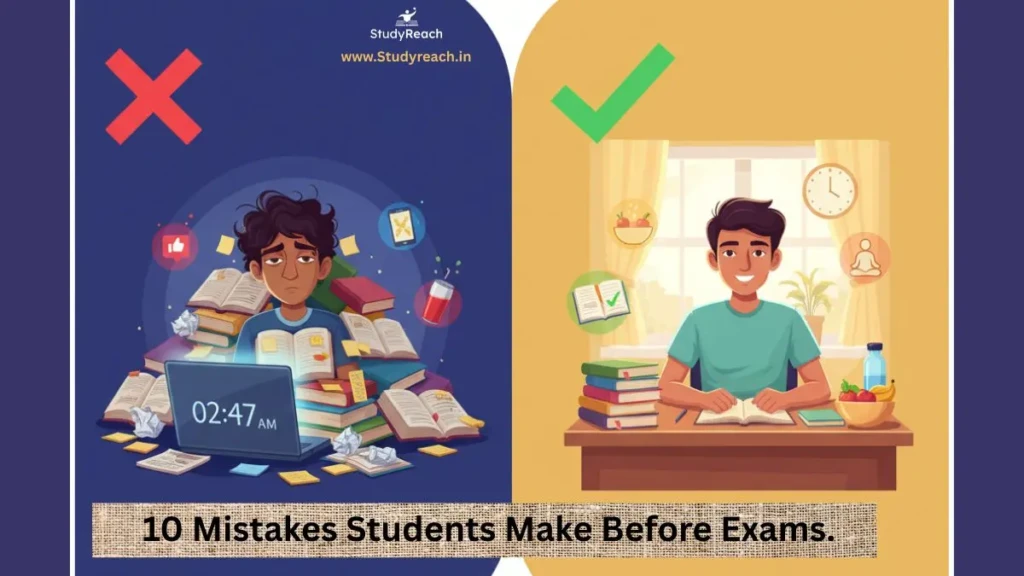
Bonus Tips to Boost Exam Performance – Mistakes Students Make Before Exams
10 Mistakes Students Make Before Exams (And How to Avoid Them)
3. They Break Everything Into Tiny Chunks
Average students look at the entire syllabus and panic. Top students break it down until it feels manageable.
Think about it: “I need to study 15 chapters” sounds terrifying. But “I’ll study one chapter today” sounds doable, right?
What they do:
- Make a list of every single topic they need to cover
- Break big topics into smaller sub-topics
- Assign one chunk to each day
- Focus on ONE thing at a time
Example breakdown: Instead of “Study Physics”
- ✓ Monday: Newton’s Laws (30 min)
- ✓ Monday: Numerical problems on Newton’s Laws (30 min)
- ✓ Tuesday: Work and Energy concepts (30 min)
- ✓ Tuesday: Practice 5 problems (30 min)
See the difference? Suddenly it doesn’t feel like climbing Mount Everest anymore. That indicates no Exam Stress.
Pro tip:
Use a simple checklist. There’s something deeply satisfying about checking things off. Your brain loves that little dopamine hit.
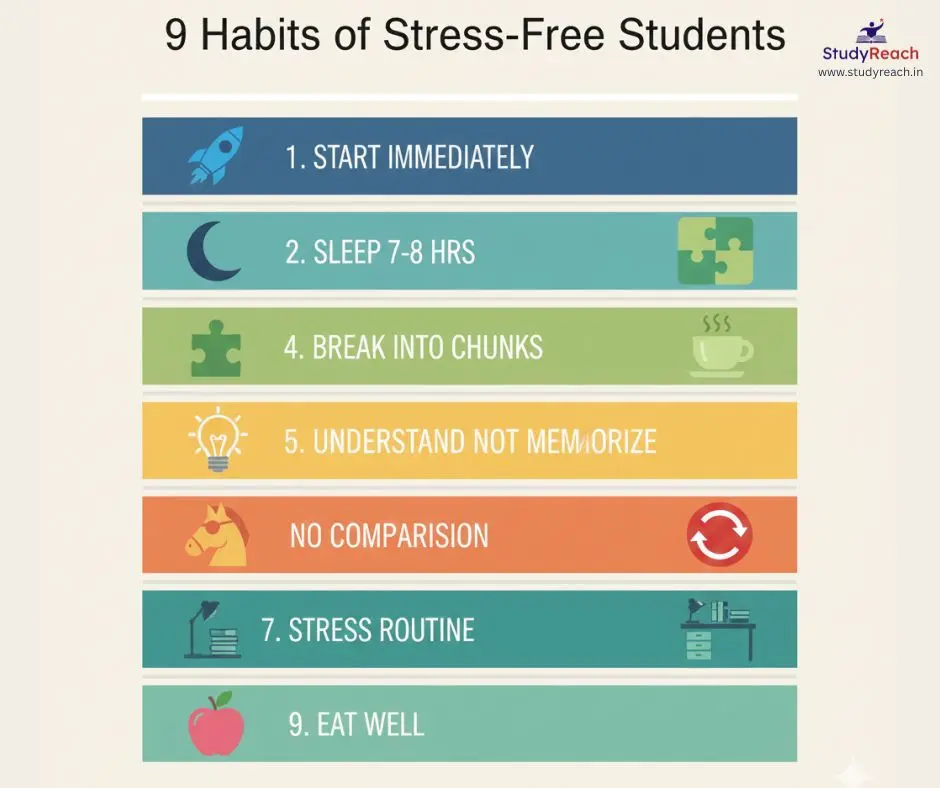
4. They Actually Take Breaks (And Feel Zero Guilt About It)
This is huge. Average students think breaks are “wasting time.” Top students know breaks are PART of the system.
Your brain is not a machine. It gets tired. And when it’s tired, you’re basically staring at pages without absorbing anything. That’s actual wasted time.
What they do:
- Take a 5-10 minute break every hour
- Take a longer 30-minute break after 3-4 hours
- Do something completely different (walk, stretch, snack, music)
- Never feel guilty about resting—it’s productive
What NOT to do in breaks:
- Scroll social media (it hijacks your attention)
- Watch “just one episode” (it never is)
- Start gaming (you won’t stop)
What TO do in breaks:
- Walk around your room or outside
- Stretch or do jumping jacks
- Drink water, eat a snack
- Chat with family for 5 minutes
- Look out the window
Trust me, when you come back, you’ll study better and faster. I’ve seen students study for 6 hours with breaks and retain more than someone who “studied” for 10 hours straight while exhausted best way to get free from Exam Stress.
5. They Focus on Understanding, Not Memorizing
Here’s what average students do for: read something 10 times and hope it sticks and stuck up with Exam stress.
Here’s what top students do: read it once, understand it deeply, and move on.
Memorizing without understanding is like building a house on sand. The moment you face a tricky question, everything falls apart.
What they do:
- Ask “WHY does this work?” not just “WHAT is the answer?”
- Explain concepts in their own words
- Connect new info to stuff they already know
- Use real-life examples to make it stick
Example:
Average student: “Mitochondria is the powerhouse of the cell” (memorized, no clue what it means)
Top student: “Mitochondria breaks down glucose to create energy—kind of like how a power plant converts fuel into electricity for a city. So yeah, it’s basically the cell’s power plant.” (understood and remembered)
When you understand something, you don’t need to memorize it. It just makes sense. And on exam day, even if the question is worded differently, you’ll still know how to answer it.
6. They Don’t Compare Themselves to Others
This is the Exam stress killer nobody talks about.
Average students constantly think: “Oh no, Riya has already finished 10 chapters and I’ve only done 3.” “Everyone seems so prepared except me.” “What if I’m the only one who fails?”
Top students? They put on blinders.
What they do:
- Focus on their own progress, not anyone else’s
- Avoid “stress conversations” before exams (“Did you study Chapter 12? I heard the numericals are hard!”)
- Stay off group chats during study time
- Remember that everyone’s journey is different
Real talk:
Someone saying they’ve “finished the entire syllabus” doesn’t mean they understood it or will do better than you. A lot of times, people exaggerate their preparation because they’re stressed too.
Your only competition is the person you were yesterday. Did you study better today than you did last week? That’s what matters.
7. They Have a “Stress Reset” Routine
Even top students have moments where they spiral. The difference? They have a plan to snap out of it.
What they do when stress hits:
- Take 10 deep breaths (sounds simple, but it works)
- Step outside for fresh air
- Talk to a friend or family member
- Write down what they’re worried about
- Remind themselves of past wins (“I’ve done hard things before”)
Emergency stress-buster:
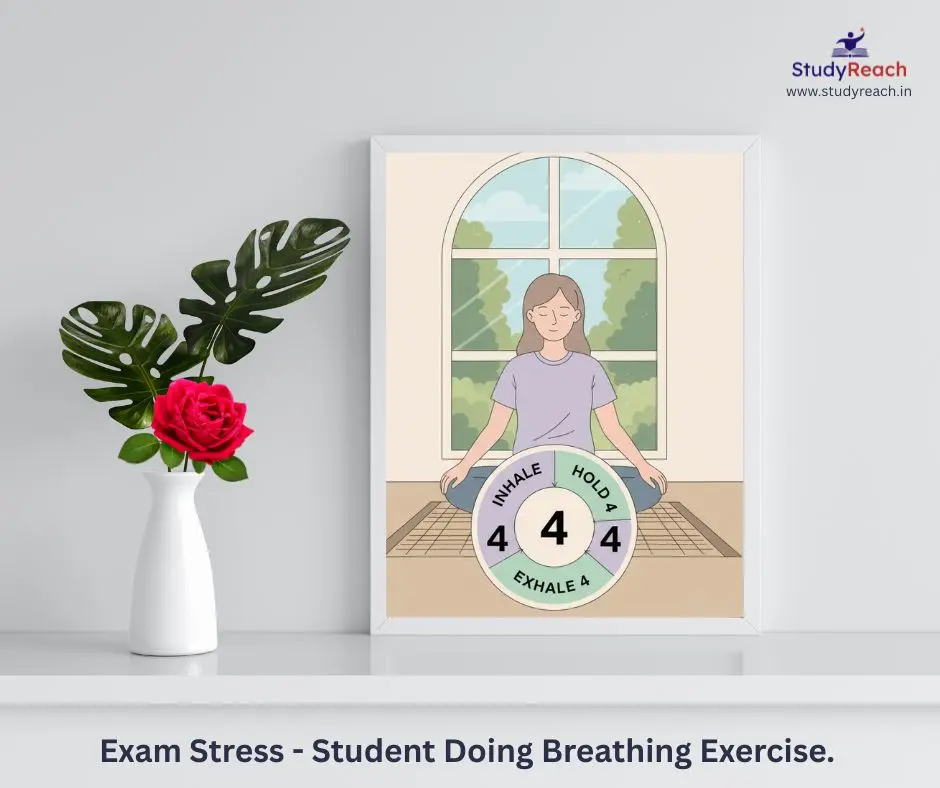
Close your eyes. Breathe in for 4 counts, hold for 4, breathe out for 4. Repeat 5 times. Your nervous system will literally calm down.
And if you’re feeling completely overwhelmed? It’s okay to take a 30-minute break and do something you enjoy. One episode of your favorite show won’t ruin your exam prep. Burnout will.
8. They Keep Their Study Space Organized
This sounds small, but it’s a game-changer. A messy desk = a messy mind.
Top students don’t waste mental energy searching for that one notebook or pen. Everything has a place.
What they do:
- Clean desk before starting (takes 2 minutes)
- Keep only what they need for that session
- Put phone in another room or on silent
- Have water, snacks, and basic supplies within reach
- Good lighting (don’t study in the dark!)
When your space is organized, your brain can focus on actual studying instead of feeling chaotic.
9. They Eat Like They Care About Their Performance
You can’t run a car on empty, and you can’t run your brain on junk food and energy drinks.
What top students eat:
- Actual meals (not just chips and coffee)
- Protein for sustained energy (eggs, nuts, yogurt)
- Fruits for quick, healthy energy
- Lots of water (dehydration kills focus)
What they avoid:
- Skipping meals
- Too much caffeine (it’ll make you jittery and crash later)
- Heavy, greasy food that makes you sleepy
I’m not saying you need a perfect diet. Just eat something that gives your brain fuel, not fog.
The Bottom Line
Top students aren’t superhuman. They’re not naturally less stressed than you. They’ve just built habits that reduce stress instead of creating more of it.
You don’t need to do all of these things perfectly. Pick 2-3 that resonate with you and start there.
Maybe it’s getting better sleep. Maybe it’s breaking your study plan into smaller chunks. Maybe it’s just taking guilt-free breaks.
Small changes, done consistently, make a massive difference.
And remember: you’re not lazy. You’re not dumb. You’re not “just not good at exams.” You’re doing your best with the tools you have. Now you have better tools.
You’ve got this. One day, one topic, one chunk at a time.
Now close this tab, take a deep breath, and get started. Even if it’s just 5 minutes. That’s enough. 💪
P.S. If you’re reading this the night before your exam and freaking out—breathe. You’ve done more prep than you think. Get some sleep, eat a good breakfast, and trust yourself. You’ll be fine.
For More Articles On Exam or Study Tips visit : Breaking News – Quick Updates on CBSE, Education, Parenting & Study Tips













2 Comments
[…] 1. What Top Students Do Differently. […]
[…] Exam Stress? Here is 9 Secrets – What Top Students Do Differently […]