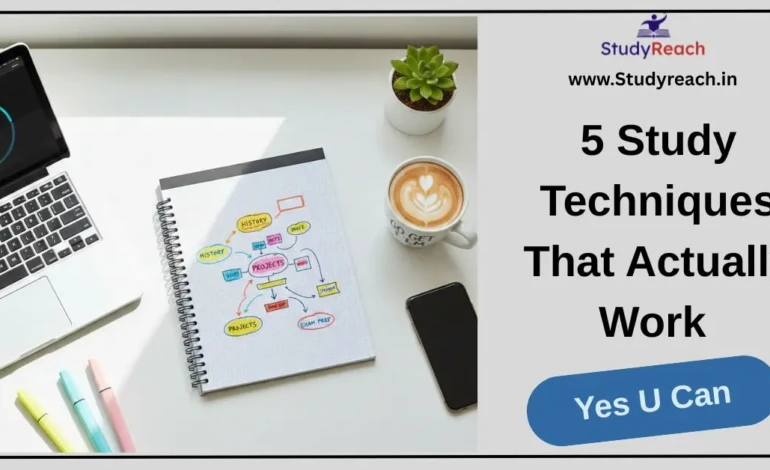
5 Study Techniques That Actually Work (Backed by Science)

Let’s be honest—most of us have been studying the wrong way our entire lives.
You know the drill: read the chapter three times, highlight everything in yellow (or pink, or green), and hope something sticks by exam day. Then you wonder why you blank out when the actual test paper is in front of you.
Here’s the study techniques that actually work: studying harder doesn’t always mean studying smarter. Science has actually figured out what works and what doesn’t. So let me share 5 techniques that’ll change how you learn—and trust me, they’re way easier than you think.
Table of Contents
1. Active Recall: Stop Re-Reading, Start Testing Yourself
What it is: Instead of reading your notes over and over, close the book and try to remember what you just studied.
Why it works: Your brain learns better when it has to RETRIEVE information, not just recognize it. It’s like the difference between recognizing a friend’s face and remembering their phone number from memory.
How to do it TODAY:
- Read a page or section
- Close the book
- Write down everything you remember
- Check what you missed
- Repeat with those missed parts
That’s it. No fancy apps needed. Just you, a blank paper, and your brain doing the heavy lifting.
Real Fact for Active Recall : The first time you try this, you’ll feel like you remember nothing. That’s normal! That struggle is actually your brain learning. Stick with it for a week and you’ll see the difference.
2. Spaced Repetition: The “Review Smart, Not Hard” Method
What it is: Reviewing material at increasing intervals instead of cramming everything the night before.
Why it works: Your brain forgets things in a predictable pattern. Review at the RIGHT time, and the information moves from short-term to long-term memory.
How to do it TODAY:
- Day 1: Learn new material
- Day 2: Quick review (10 minutes)
- Day 7: Review again
- Day 14: One more review
- Day 30: Final review before exam
Pro tip: Use a simple calendar or reminder app. Or try free apps like Anki or Quizlet that do the spacing automatically.
I used this during my final semester, and honestly, it felt like cheating. I was reviewing LESS but remembering MORE. The key is consistency—don’t skip those review days.

3. The Feynman Technique: Explain It Like You’re Teaching a 10-Year-Old
What it is: Take a concept and explain it in the simplest language possible, as if you’re teaching someone who knows nothing about it.
Why it works: If you can’t explain something simply, you don’t really understand it. This technique exposes the gaps in your knowledge FAST.
How to do it TODAY:
- Pick a topic (let’s say “Photosynthesis”)
- Write it out or say it out loud like you’re explaining to a kid
- No jargon allowed! If you say “chlorophyll,” explain what that actually DOES
- When you get stuck, go back to your notes
- Simplify it even more
Example: Instead of “Plants convert light energy into chemical energy through photosynthesis,” try “Plants eat sunlight and turn it into food they can use.”
Do this for every tricky topic. You’ll be shocked at how much clearer things become.
Read more on “Feynman Technique”
4. Pomodoro Technique: Work in Bursts, Not Marathons
What it is: Study for 25 minutes straight, then take a 5-minute break. Repeat.
Why it works: Your brain can’t focus for hours at a stretch—it gets tired. Short bursts keep you fresh and prevent burnout.
How to do it TODAY:
- Set a timer for 25 minutes
- Study with ZERO distractions (yes, put your phone away)
- When the timer goes off, take a 5-minute break
- After 4 rounds, take a longer 15-30 minute break
What to do in breaks: Walk around, stretch, grab water, look out the window. DO NOT scroll Instagram—that’s a black hole.
This technique saved me during exam prep. I used to sit for 3 hours and get nothing done. Now I do four 25-minute sessions and actually finish chapters.
5. Mind Mapping: Turn Boring Notes Into Visual Stories
What it is: Instead of linear notes, create a visual diagram with the main topic in the center and branches for subtopics.
Why it works: Your brain loves visuals and connections. Mind maps help you see the BIG PICTURE and how everything links together.
How to do it TODAY:
- Take a blank page
- Write the main topic in the center (draw a circle around it)
- Draw branches for major subtopics
- Add smaller branches for details
- Use colors, symbols, tiny drawings—make it YOUR style
Example: For a history chapter on World War II:
- Center: “WW2”
- Branches: Causes, Major Events, Key Figures, Consequences
- Sub-branches: Under “Major Events” → Pearl Harbor, D-Day, Hiroshima
This isn’t just pretty note-taking. When you draw it, you’re processing the information differently. And when you review, one glance at your mind map brings everything back.
The 7-Day Challenge
Want to actually TRY these instead of just reading about them? Here’s your simple challenge:
- Days 1-2: Use Active Recall for one subject
- Days 3-4: Try Pomodoro technique for your study sessions
- Days 5-6: Create a mind map for your toughest topic
- Day 7: Explain one concept using the Feynman Technique (to a friend, parent, or even your pet!)
Track how you feel. I bet by day 7, you’ll be studying less and remembering more.
Final Thoughts
Look, I’m not saying these techniques will magically make you top of the class overnight. But they WILL make studying way less painful and way more effective.
The biggest mistake students make? Thinking that more hours = better results.
It’s not about how LONG you study—it’s about HOW you study.
Pick one technique from this list. Just ONE. Try it for a week. See what happens.
And hey, if it works for you, come back and let me know. I love hearing student success stories!
Now stop reading this and go try Active Recall. Seriously—close this tab and test yourself on what you just read. 😉
Happy studying!
Related Article :
10 Critical Mistakes Students Make Before Exams
How Students Can Learn More In Less Time
This article is also a part of “Breaking News – STUDY TIPS – Your One Stop Destination”











2 Comments
[…] Here’s the study techniques that actually work: studying harder doesn’t always mean studying smarter. Science has actually figured out what works and what doesn’t. So let me share 5 techniques that’ll change how you learn—and trust me, they’re way easier than you think. click […]
[…] Effective Study Tips for Students […]